This was an magical semester. I went all in on developing a new (to me) course, MAT A02: The Magic of Numbers. I inherited this course after it had bounced around among various faculty members for a while and I decided to re-write it from the ground up.
| Week | Highlights |
|---|---|
| 43 | The Emberverse series. A FYMSiC piece on Seminar. |
| 44 | Seminar: A Place to Sow Seeds. Seminar talk about $\sin(x)$ and Iterated Involutions. |
| 45 | 18 Year Anniversary. Schnapsen. |
| 46 | Meg gets a permanent job offer. |
| 47 | Reading Week. Growing Linearly Independent Sets. Multiple choice grading. |
| 48 | Crazy fun. Bridges sent. |
| 49 | Kaweco Sport Brass is back! Rationally Designed String Figures. Perfect shuffles. |
| 50 | Seedy Saturday. Secret BISFA writing project begins. |
| 51 | Sick. Community garden at St. Dunstan |
| 52 | One year of Week Notes! Esperanto books. Pigeonhole and Dimension. |
| 53 | Community garden. |
Traditionally, this course goes fairly directly through elementary number theory leading up to basic cryptography like RSA and the Diffie-Hellman key exchange. I decided to completely re-do it. The course now does something rather different.
Briefly we do:
I feel like groups, in general, are a nicer place to wind-up than cryptography. The pictures are nicer, it feels artsy, the idea is more general. You can do more with them. One way to think of groups is that they’re “the abstract algebra version of multiplication and division.” We pushed the narrative of “numbers” to its limit.
We also did a lot of in-class activities. These were very experimental for me. I don’t usually ask my students to get up, move around, and do stuff. I’m quite surprised by the most popular in-class activity. It was The Fitch Cheney 5-Card Trick. I think students felt it was fun and game-like.
One activity, early in the course, that astounded me was asking “What languages can you count in?” Turns out, in our class of ~120 students, we could count in ~25 languages. Absolutely awesome.
Various other activities need some work:
One pedagogical move that I did with this course was to replace all TA hours allocated to grading with in-class activities. This meant that all the assessments were multiple choice, but that TAs were present for lecture. This created a very cool dynamic for active learning. It was a great move. The students got a lot of support, I had people helping in the class, I knew my TAs and their strengths, and the TAs made friends1.
The course ended with a mathematics festival. This was also quite experimental for me. The students were asked to present something cool, using physical props, related to mathematics. From top to bottom: Fibonacci poetry2, musical beats, plant morphology, Mine Sweeper, and name tages written in ASCII / binary. (The last image was photo-edited together by the student.)
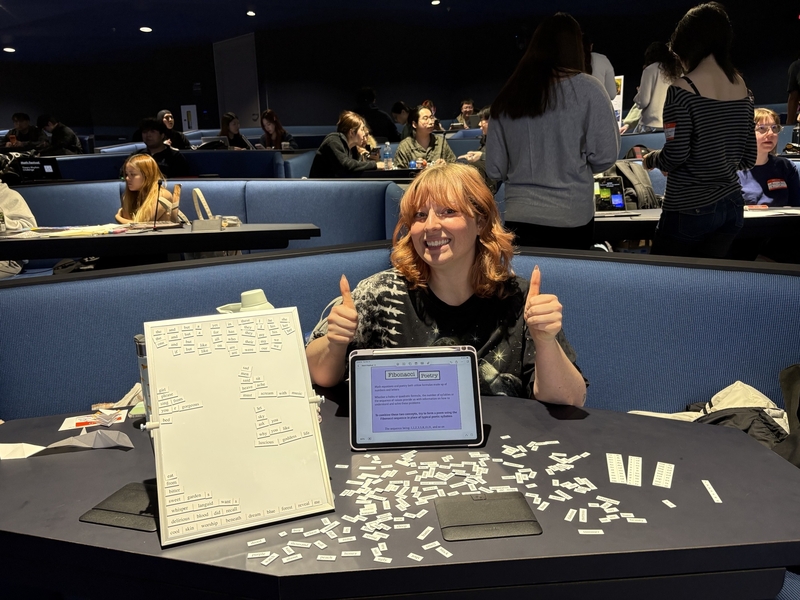
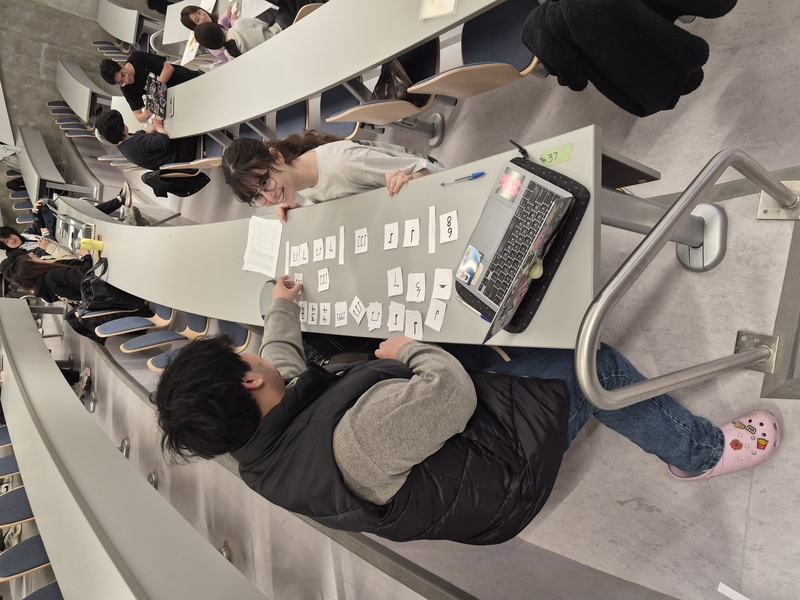
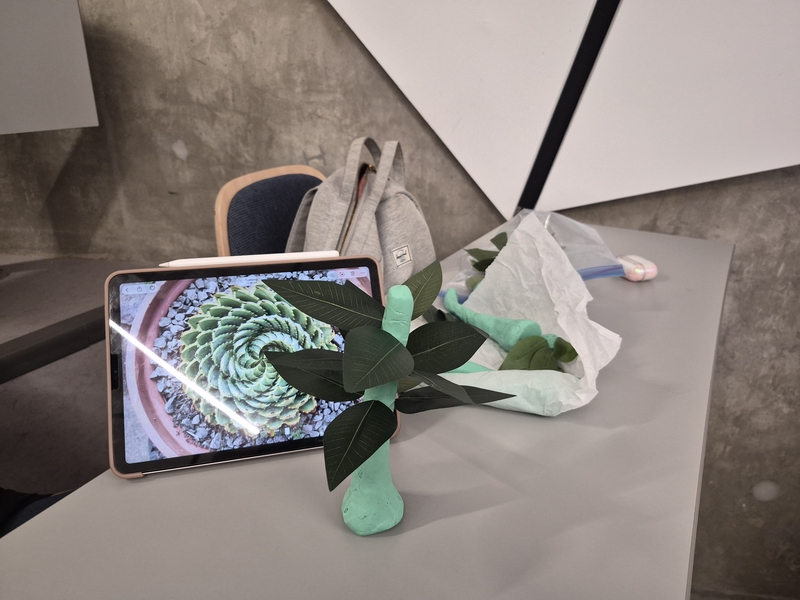
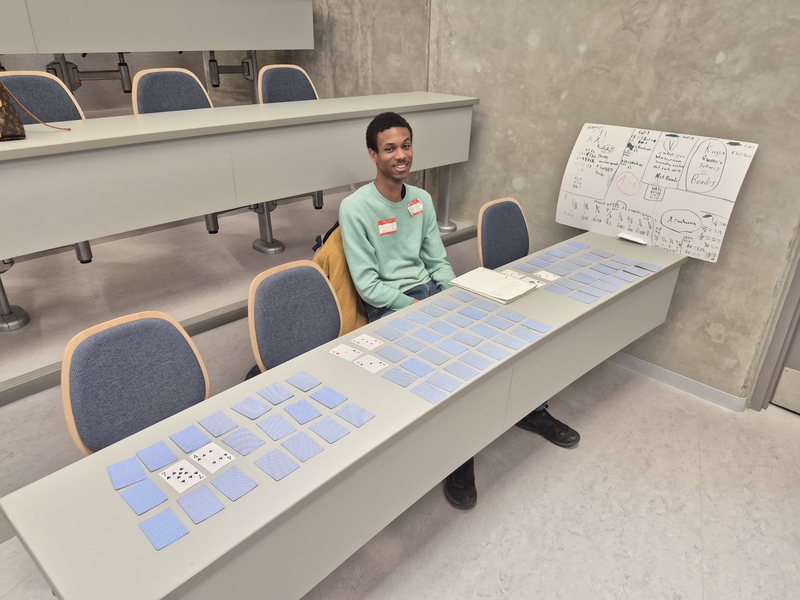
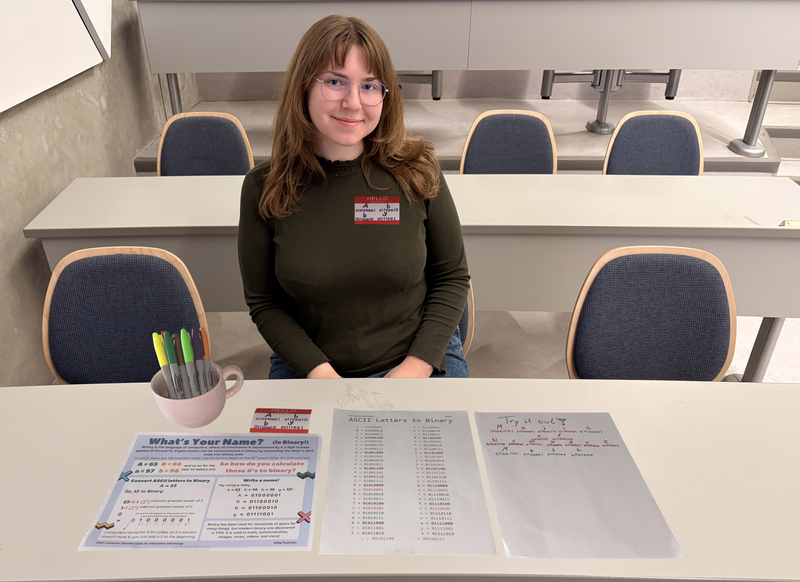
Overall, it was a novel experience. Some students made amazing presentations. One person literally read ChatGPT off their phone. Another hastily drew a hares and hounds board on their iPad. I think that next time, I’ll add the stipulation: zero techonology. No presentations. No posters. You need to tell someone something in real life.
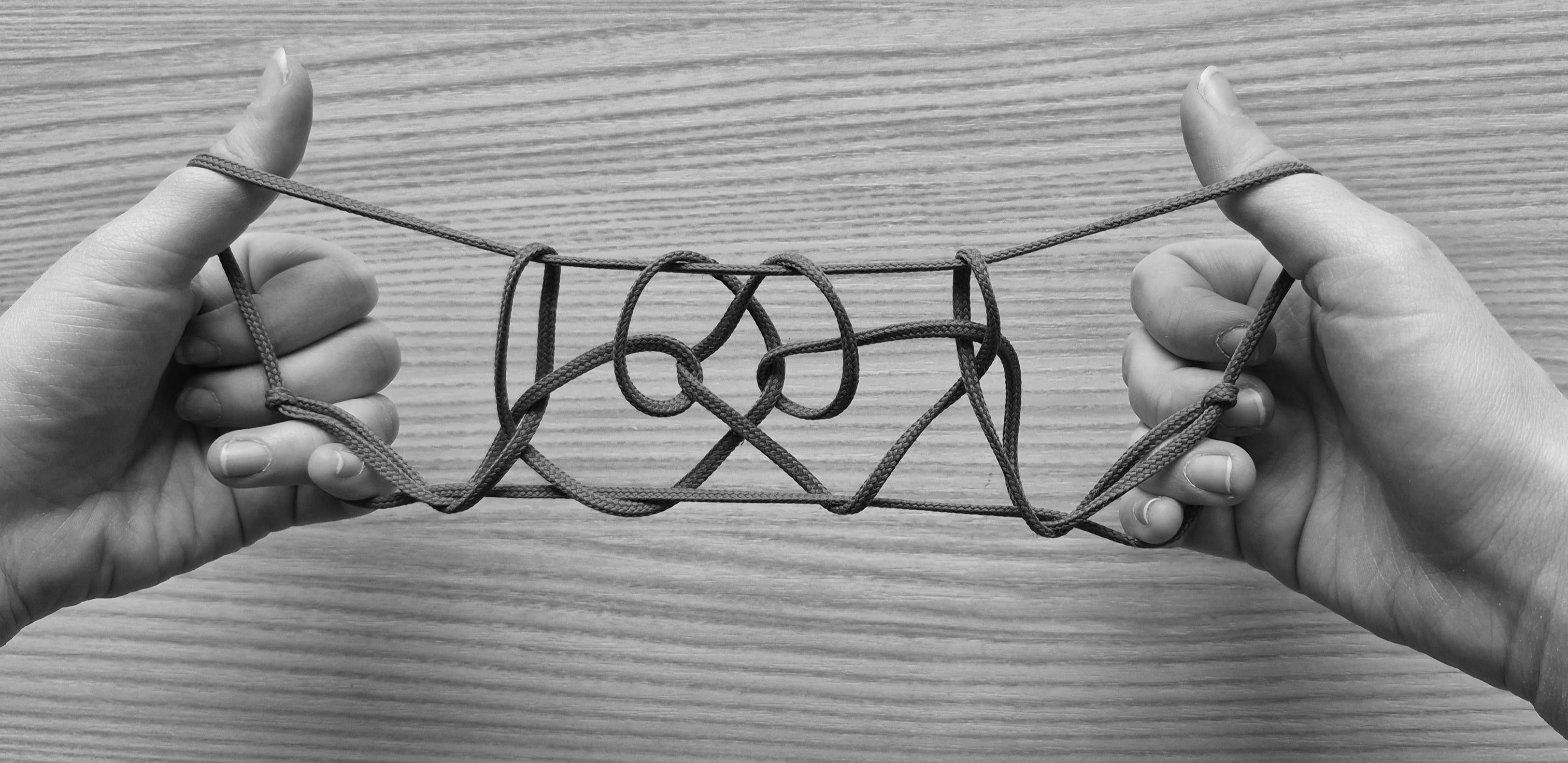
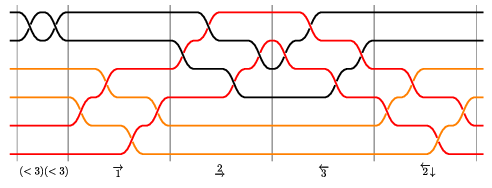
This course was also magical. A once in a lifetime experience. The last time I taught an intense string figure course was back in 2018. It has been a while since I went really deep in to this stuff with a student. The results were awesome. Some of the blackboard shots are here D92. Ooops! I got the course code wrong everywhere. We wrote a paper for Bridges and one for BISFA. They both got warm reviews, and we expect to share them soon.
Published: Apr 8, 2026 @ 22:17.
Last Modified: Aug 16, 2026 @ 07:12.
Thanks for reading! If you have any comments or questions about the content, please let me know. Anyone can contact me by email.