This week was spent at Bridges in Galway, Ireland. It was the “end” of MAT D92. I flew to Ireland with my student, Ness Schattman, and we presented our workshop Of Loops, Braids, and String Figures: The Loopy Calculus of Cat’s Cradle. We had a blast.
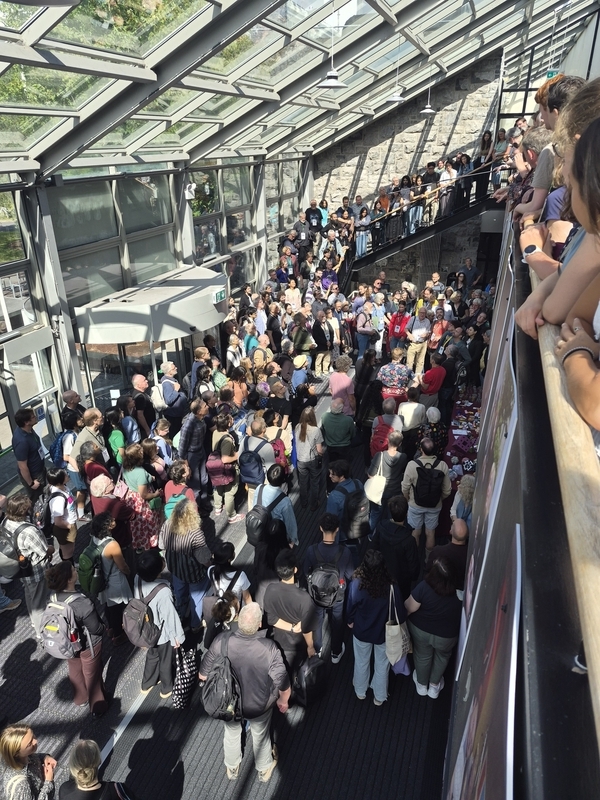
Bridges is an overwhelming conference. One is just bombarded with cool math/art ideas. Everyone seems to have a cool art piece or idea to share. If you ask anyone, they’ll show you something amazing and chat your ear off about it. It’s the sort of place where people get excited about modular kirigami knitting, basket weaving Gauss codes, and some knitting instructions begin tie your circular needle in to the shape of your favourite knot.
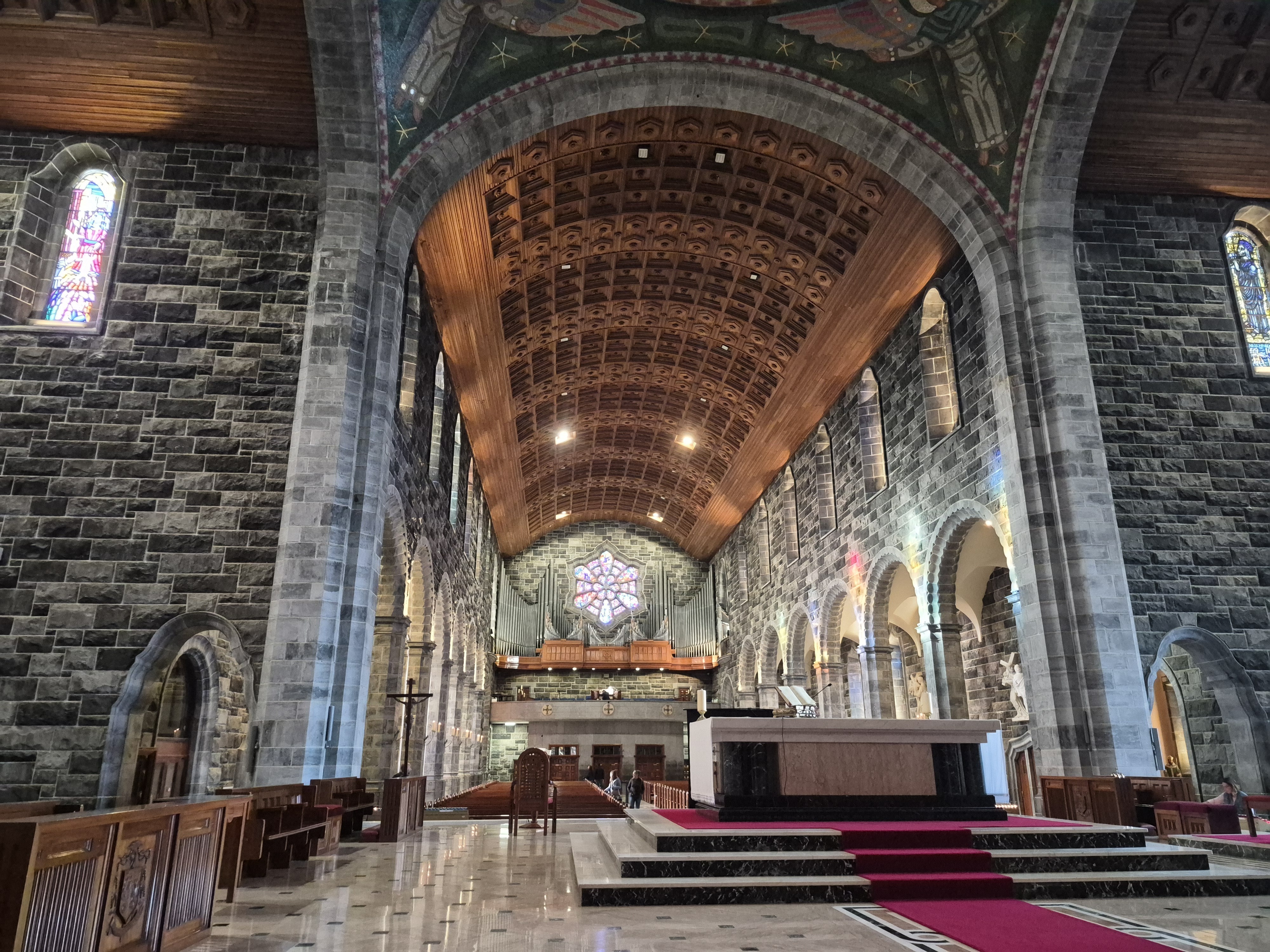
I didn’t to much tourism in Galway. Mostly, I just walked around town and enjoyed the street music. Here is a lovely shot from inside Galway Cathedral. The photo does not do justice to the extreme scale of the space. I felt absolutely humbled by the architecture. You can click the image below to enlarge it; try to spot see the tiny organist in the back.
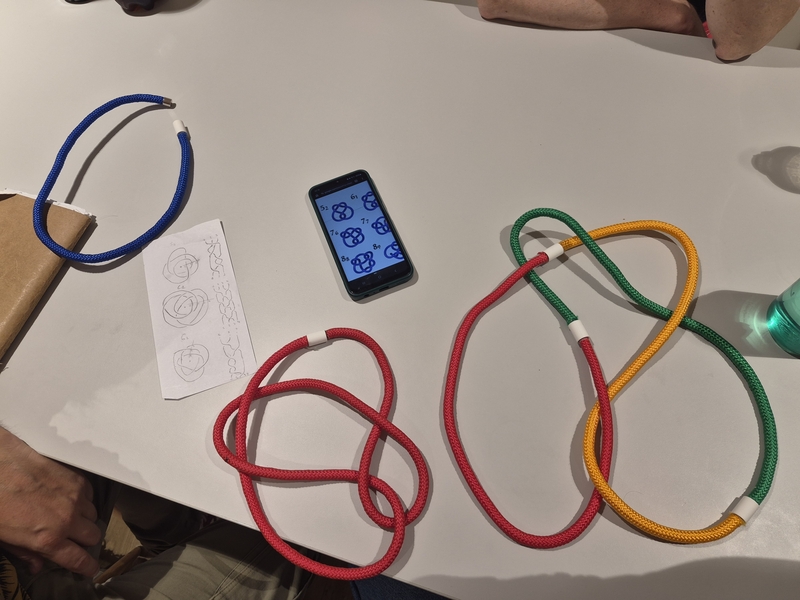
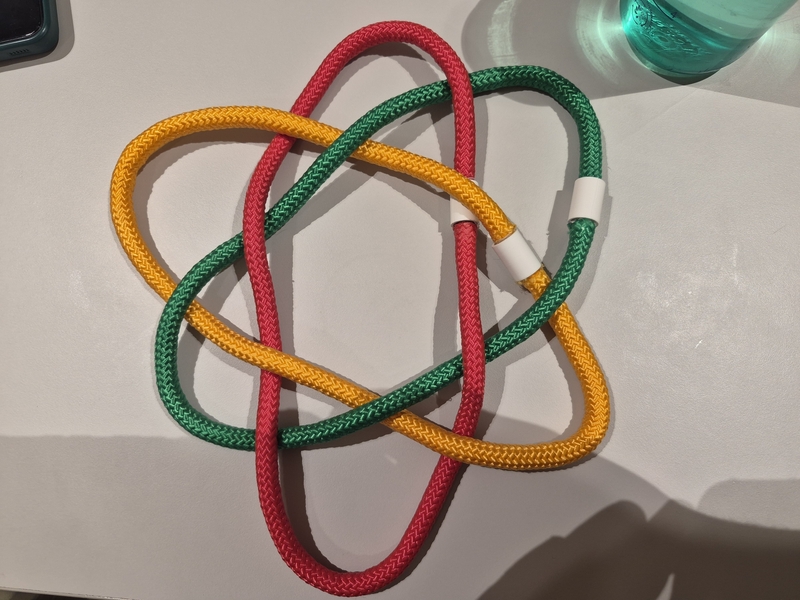
On the way home from dinner a new friend, François, led me through a little activity around Alexander’s Theorem. First, he asked me to pick a knot in the first few rows of a knot table. If picked the beautiful $5_2$. He asked me to tie the knot by hand, using the long red rope shown in the photo below. Tying the knot proved to be a bit tricky. He then looked up the corresponding braid, gave me the red, orange, and green ropes and asked me to braid it. This proved to be much easier! We also made a borromean link, the second image below, by braiding $(\sigma_1\sigma_2^{-1})^6$ and closing it up.
The string figures and loop braids workshop went well. We had a great room for it. A large chunk of the workshop requires two people to make a string figure together. My friend, Louisa Bufardeci, introduced the term “tacking” for making string figures in this way. Participants were seated side by side at desks with aisles that we could walk up and down. We had enough room for everyone and managed to pair everyone up. A perfect space for the workshop.
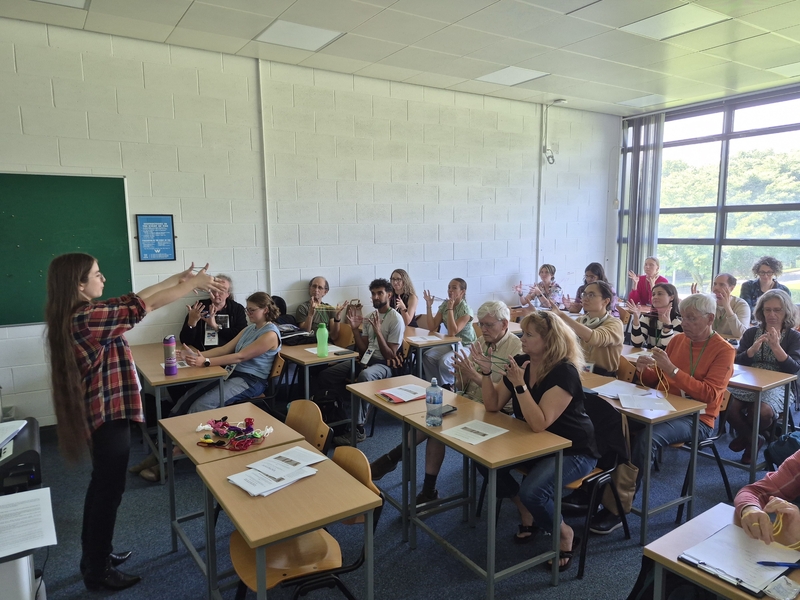
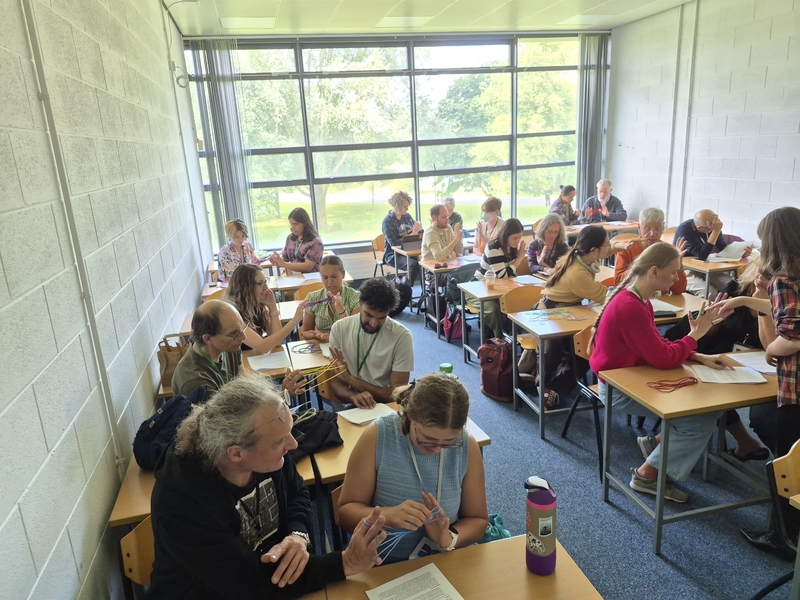
Moreover, we had great participants.
This is the real joy of giving talks:
receiving stimulating feedback from awesome participants.
Nancy Scherich brought lots of heavy duty ideas from knot theory.
Karl Schaffer attended our workshop and asked us
if we knew of any string figures which began with a knotted string.
We did knot.
And so, I asked to him if he would like to play with the idea sometime.
He made a trefoil knotted string for the occassion.
After the talks on Thursday, we got together and played with the knotted string.
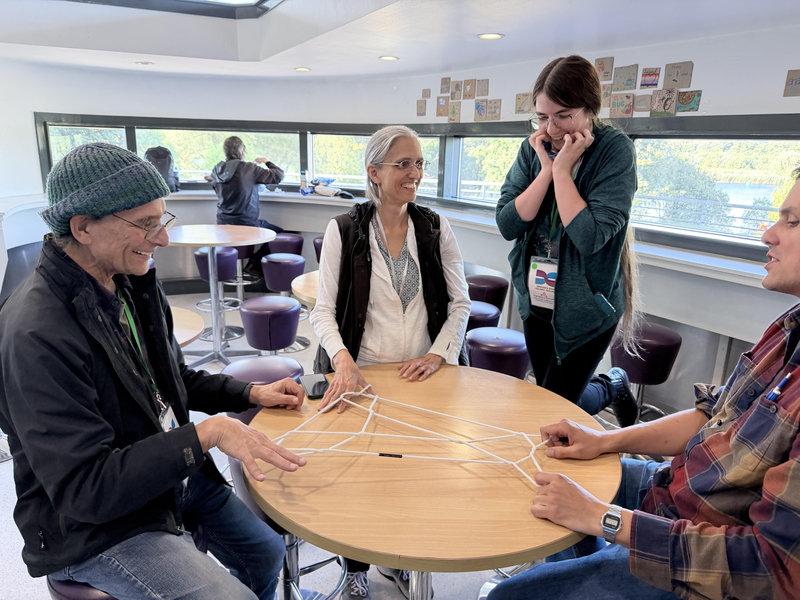
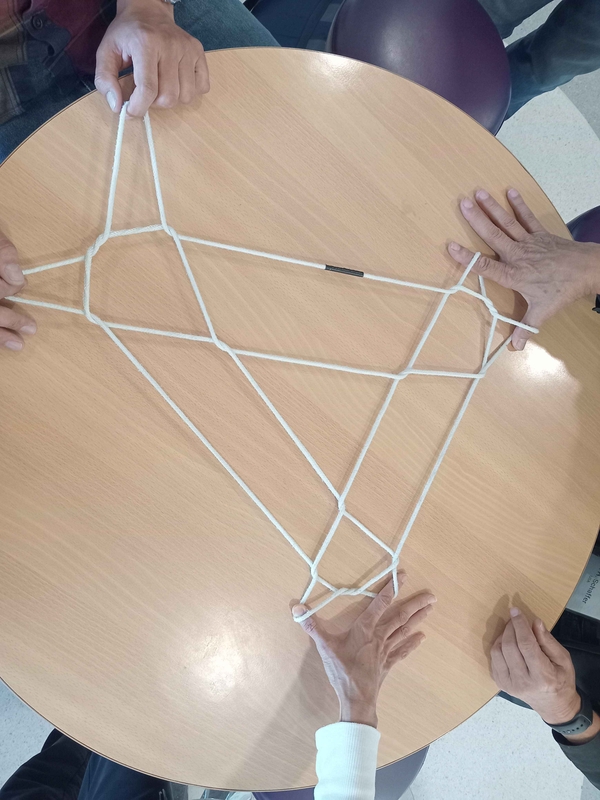
Karl Schaffer, Laurel Shashtri, Ness Schattman, and myself realized the string figure above. It has three-fold rotational symmetry and is, in fact, a knot. This is, to my knowledge, the first ever knotted string figure.
It took us a while to get used to using the knotted string. Eventually, we settled in to having three people use their right hand to manipulate the string. It was helpful to have three similar hands as opposed to a mix of rights and lefts. We also found it helpful to receive directions from a fourth person “outside” the figure. Ness made the figure Two Diamonds, called out the directions to us, and we did the right hand movements for each step in the construction. In the photos above, I am holding the string incorrectly. To get the full effect, I should be holding the string with my right hand like Karl and Laurel.
These are some lines from various talks that I wrote in my notebook. To get them out of my paper ecosystem, I’m posting them here.
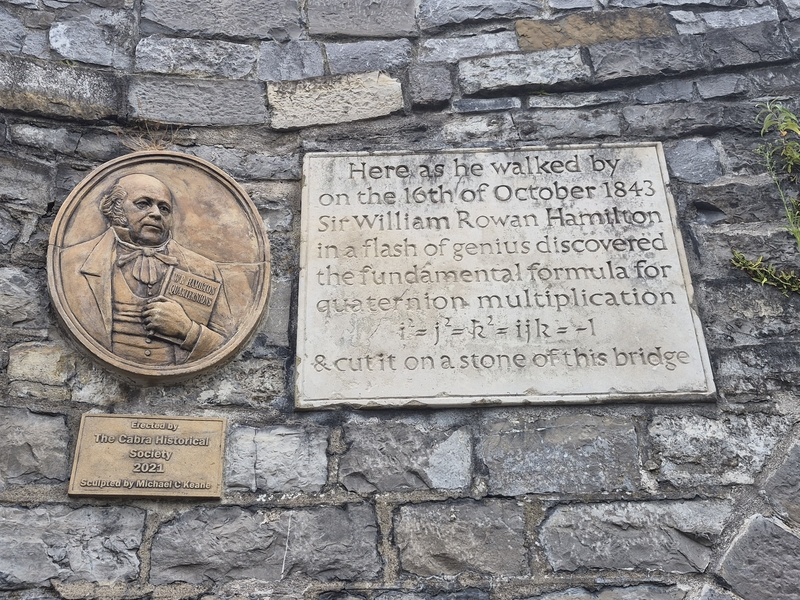
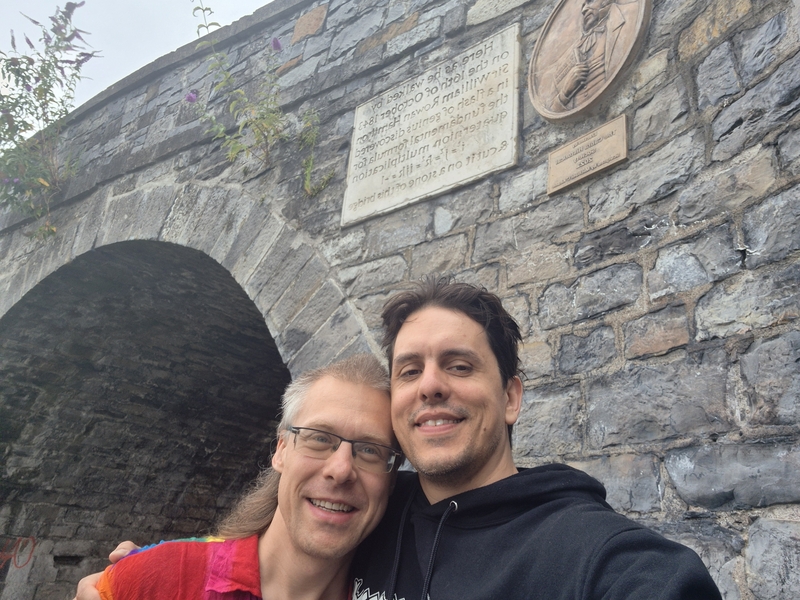
After Bridges, I headed to Dublin to meet up with Alex Fink and Sai. We all stayed together at Trinity College. Alex and I made a pilgrimage out to see Broom Bridge, the birth place of quaternions. The plaque reads as follows.
Here as he walked by on the 16th of October 1843 Sir William Rowan Hamilton in a flash of genius discovered the fundamental formula for quaternion multiplication $$ i^2 = j^2 = k^2 = ijk = -1 $$ & cut it on a stone of this bridge.
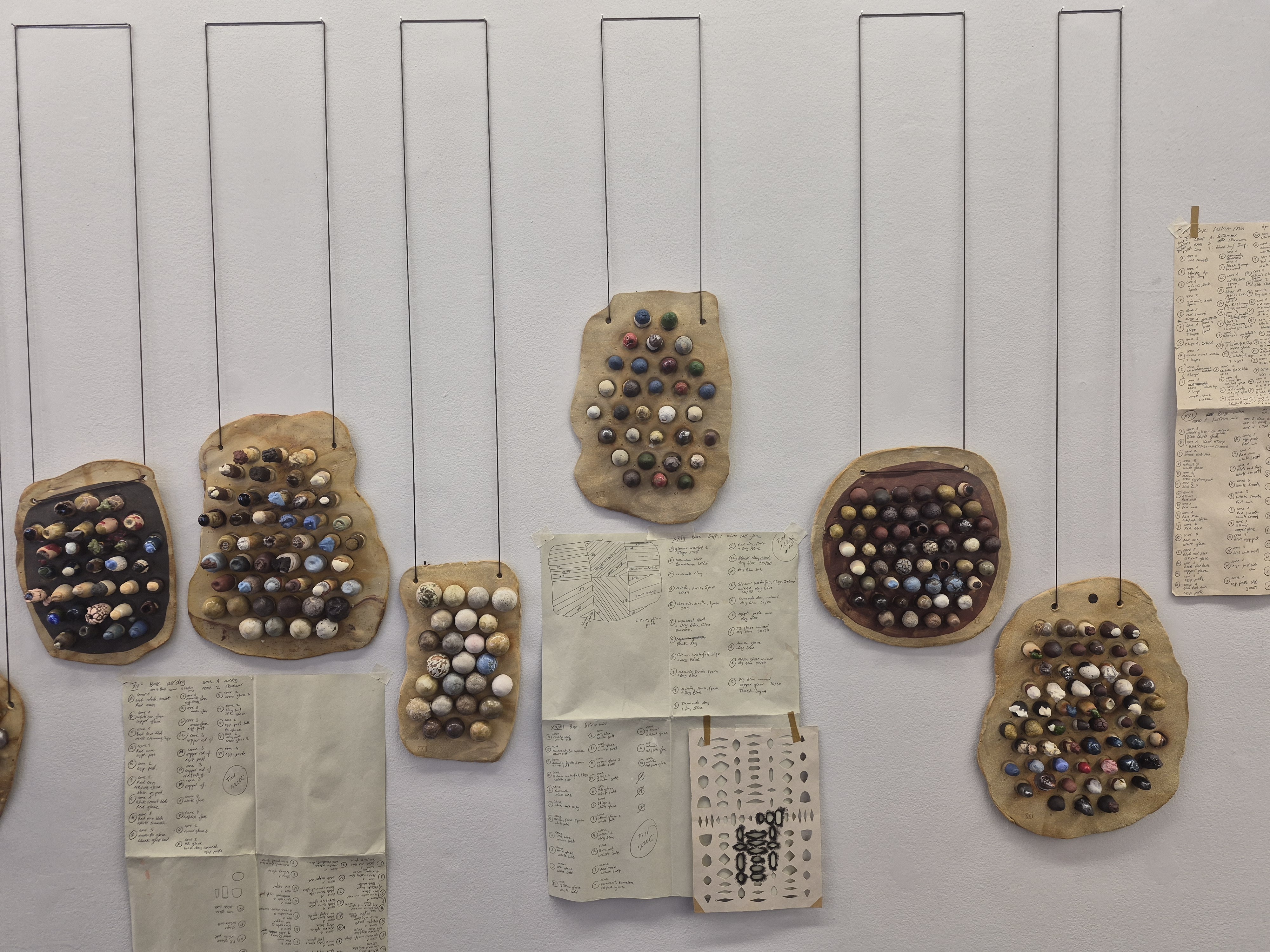
While out looking for souvenirs, I bumped in to a lovely art exhibit, (O-O-O) by Vanessa Donoso López. It had a strong craft aesthetic. The artist brought many of the pieces from her studio above the gallery; and so, the exhibit felt like walking through a working pottery studio. López also cultivates a mathematical, or at least methodical, aesthetic in her work. You can click to enlarge the picture below.
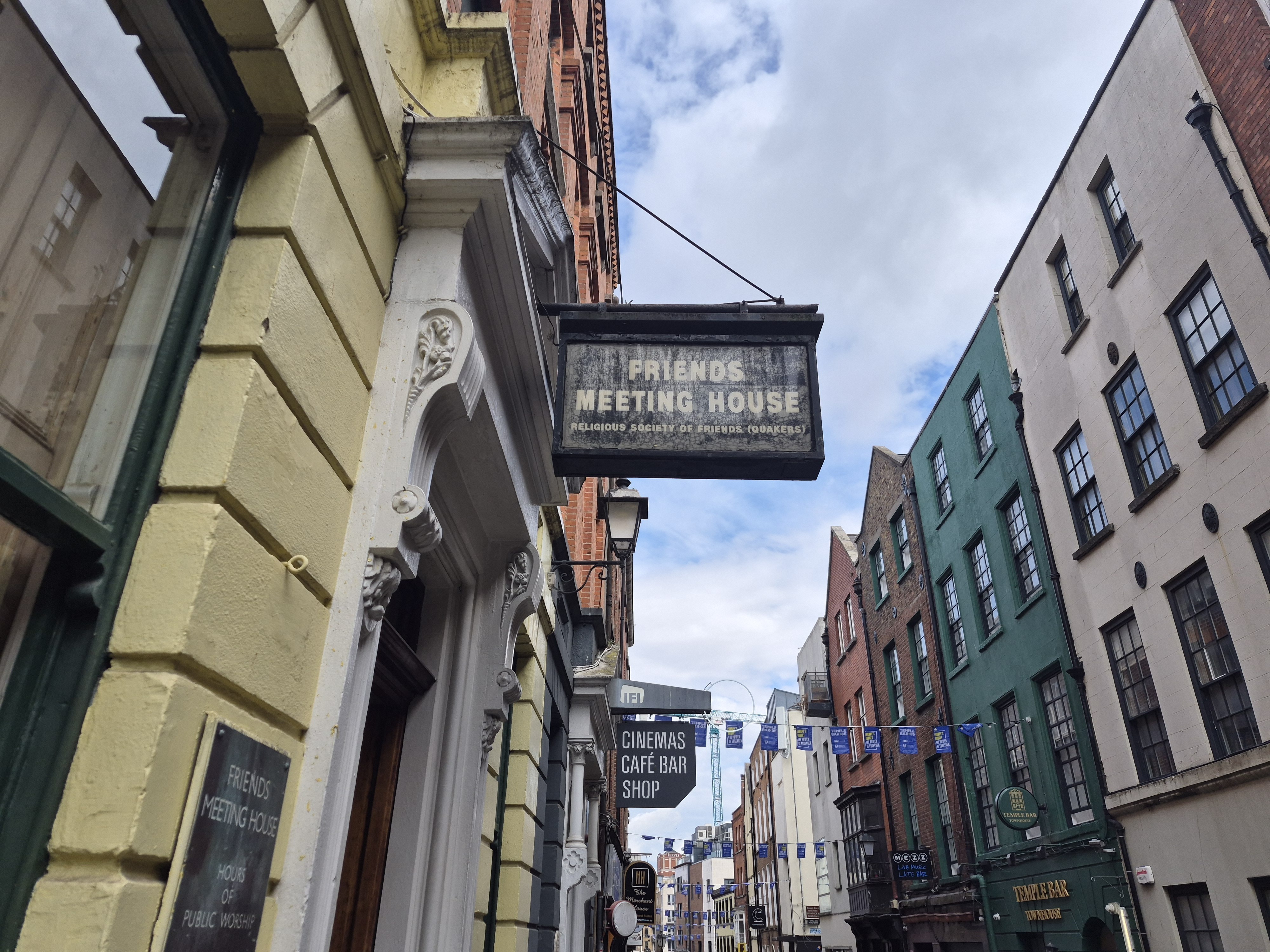
On Sunday morning, Sai and I visited Eustace Street Meeting. I arrived about twenty minutes early and so got an extended period of worship. The Meeting has a lovely space full of well worn pews. They had many Bibles and copies of Faith and Practice set around the room. To my great surprise both books were read extensively during Meeting. After Meeting, we hung back to enjoy the fellowship time. The under-fourty crowd was well-represented, though many of us turned out to be visitors.
Le Guin, Ursula K. The Tombs of Atuan.
I read this on my Kobo and enjoyed it. I love the way that Le Guin turns high fantasy tropes on their heads. The way she weaves pacifism and feminism in to her plots just sends me. I look forward to reading the rest of the series.
While reading, I had an experience which highlights the distinction between ebooks and physical books.
The epub file that I’m reading has all six books of the series in it.
As I was reading, I suddenly came to the end of the Tombs of Atuan.
I hit the next page button and was presented with the Afterword.
You never surprise yourself by turning to the last past of a physical book.
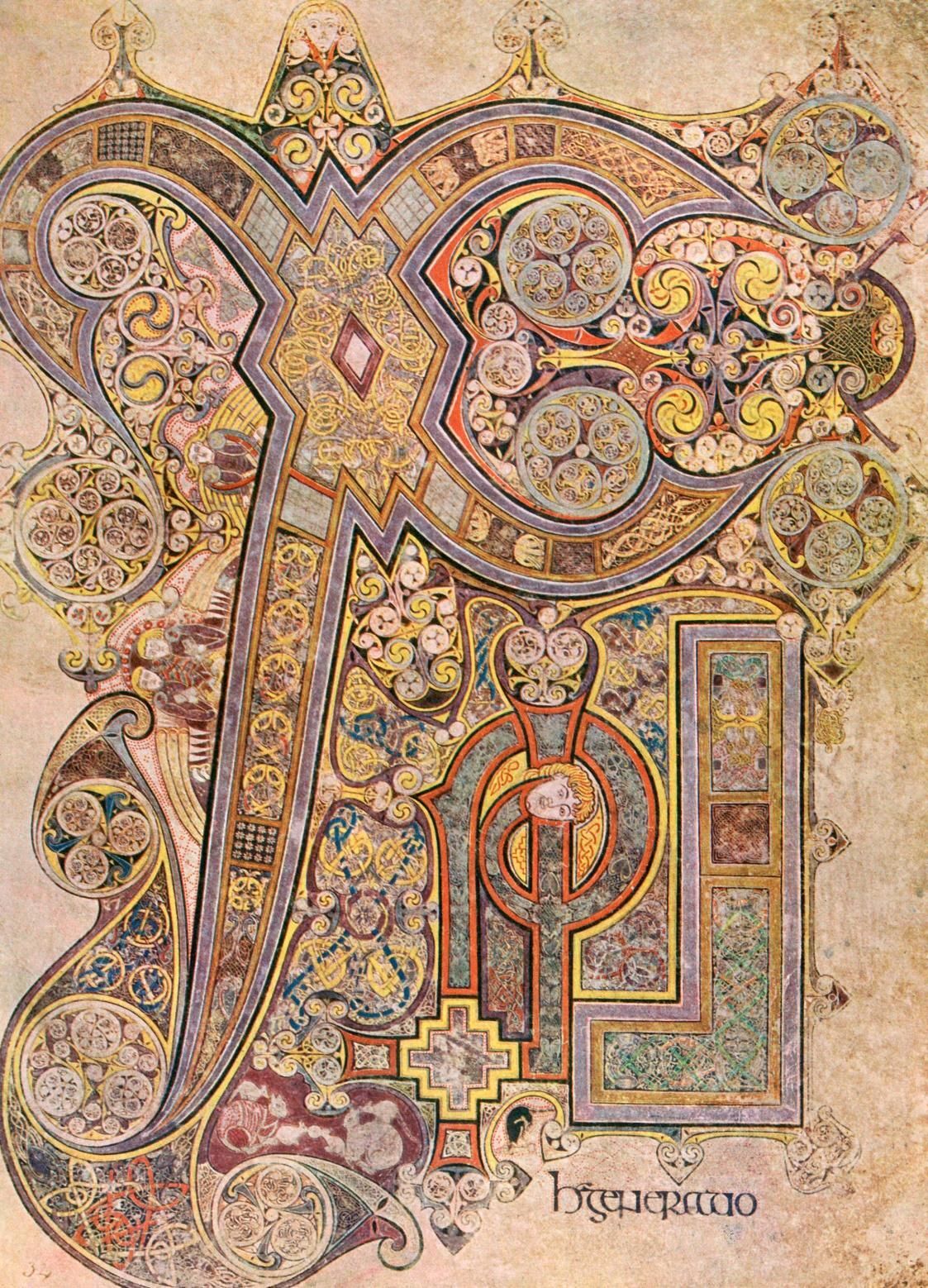
While we were staying at Trinity, we did the Book of Kells Experience. The tour is split in to two parts: Chapter 1 which covers the Book itself and the Long Room, and Chapter 2 which is a bunch of electronic media and a gift shop. I won’t spend much time on Chapter 2 except to say that it reeks of someone getting a huge grant to do work with digital projectors. I wouldn’t recommend the second half of the Experience to anyone. The first half, though, was awesome.
All through Chapter 1, we geeked out about the language and calligraphy. The endless patience and attention to detail. It is scarcely imaginable that the Book of Kells was made by human hands. Moreover, it’s a miracle that the Book came down through the centuries unharmed. One very understated exhibit showed a chronology that included the following.
1016 Kells destroyed by fire.
1040 Kells and its ecclesiastical buildings destroyed by fire (and again in 1060, 1095, 1099, 1111, 1135, 1143, 1144, 1150, 1156, …)
That’s right, Kells was destroyed by fire at least eleven times! I have no idea what the ominous ellipses at the end contains. The book is a millennium old and survived a tonne of fires. It was stolen, had its gold casing removed, and was buried at some point. And yet, there we were, looking at it in a museum display. Absolutely wild story. The Book is opened to John 6:28-42 or 308v-309r.
For me, there was a simultaneous appreciation of the work as: a historical object, a graphic artifact, an act of devotion, and a cosmic vision. The secular and religious re-enforce each other. I was amazed by the cosmic vision that the embellishments depicted. They were like a graphic analogue of the Divine Comedy. Layers, on layers, on layers on meaning. At the level of craft, the secular level, it represented an unbelievable amount of work. One exhibit said that the vellum would have required around two hundred calves. That’s a lot of cows!
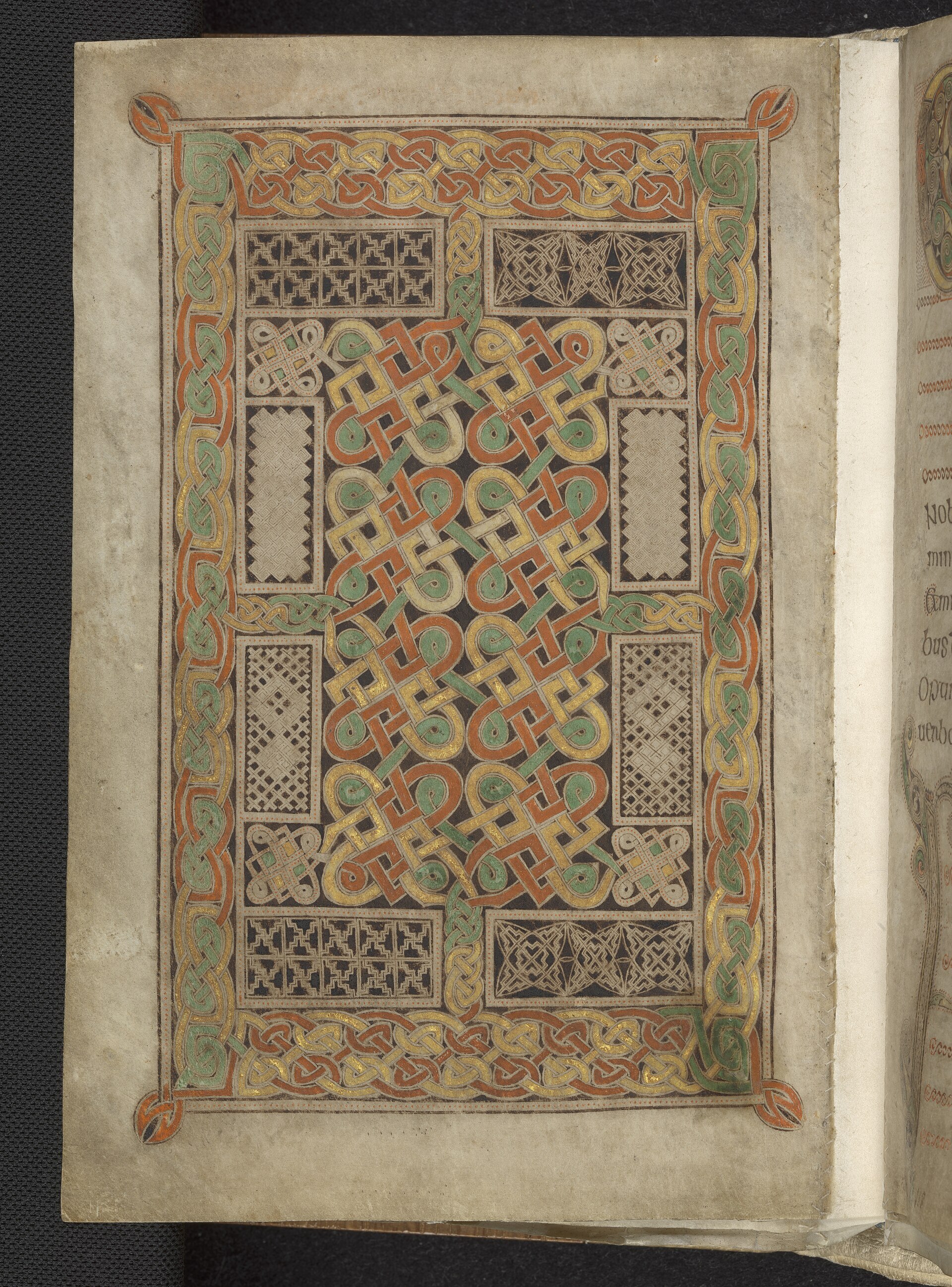
They also had beautiful examples from the Book of Durrow on display. (Click to enlarge.)
Most of the talks that I attended at Bridges 2026.
Some awesome people that I met at Bridges 2026
Japanese stitching
Labyrinths / Mathematical Dance
The Storyteller by Walter Benajamin
Published: Aug 9, 2026 @ 19:00.
Last Modified: Aug 31, 2026 @ 21:59.
Thanks for reading! If you have any comments or questions about the content, please let me know. Anyone can contact me by email.