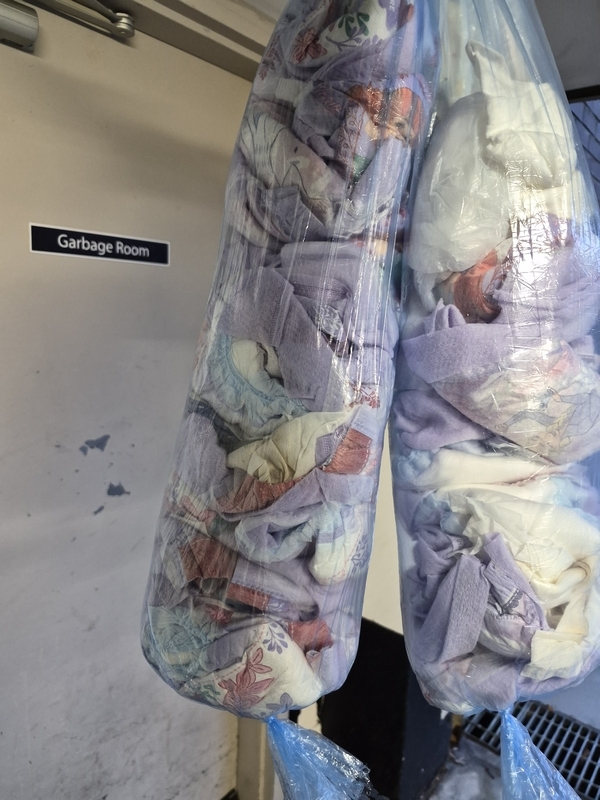
Mabel has been out of diapers for a month or two now. We realized yesterday, with creeping horror, that the diaper pails hadn’t been emptied since she started potty training. I emptied them1 and thus threw out my last bags of diapers. Unless a friend asks me to change their kid’s diaper, I think that these might be the last diapers that I handle until my kids have kids.
We’ve had at least one kid in diapers for the last six years. There was one week of overlap when Mira and Mabel were both in diapers. At that point, Mira was three years old and she could understand that two kids in diapers was too much. She also barely fit on the change table.
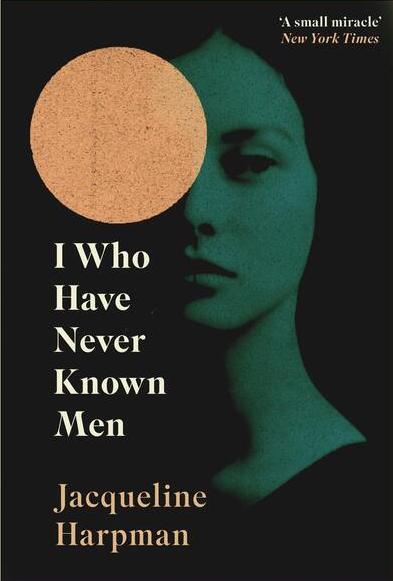
Harpman, Jacqueline, and Sophie Mackintosh. I Who Have Never Known Men , Translated by Ros Schwartz, Vintage, 2019.
The TPL website describe this book as:
Ursula K. LeGuin meets The Road in a post-apocalyptic modern classic of female friendship and intimacy.
This led me to an instant desire to read the book. It was an unexpected page turner; I finished it in about a day, staying up late to read it. It makes me want to read other short experimental or philosophical novels.
The premise of the book is that forty women find themselves locked in an underground cage with no memory of how they got there. They’re watched over by male guards who will not communicate with them. One day, a siren goes off at the very moment the guards unlock the cage to give the women food. The guards flee, the women escape, and find themselves in a strange land. The novel follows the main character, known only as the child, as she out lives all the other survivors. She wanders and explores the absurd world she finds herself in.
I feel that the novel leaned too much in to absurdism. One could hear Beckett and Sartre plays rattling away in the background. There was also a dusting of religion; the title feels like a riff on Luke 1:342.
I think that I want more Ursula K. LeGuin in this one.
After the women leave the cage, they don’t do much. They spend some time scoping out other bunkers and realize that everyone else died. Eventually, they settle and make a sort of village. That settling could be the start of a fascinating novel, but this novel is not it. They don’t really develop a new culture. There isn’t any world building after their escape.
I think that the novel misses a fundamental aspect of human nature. We’re creative. We make the best of any situation. We tell each other stories. I can imagine a rich and complex matriarchy forming after their escape. Elaborate song cycles and myths about the meaning of their situation. And we just don’t get that in this telling of their story. The Emberverse series by S. M. Sterling, which I was reading back in Week Notes 43, does a better job of this.
Maybe this lack of creative spark is the absurdism talking? It could be trying to make a point about the absurdity of modern life. I just don’t think it would play out as it does in the novel. It’s somewhat senseless to write about the “realism” of speculative fiction, but this is not especially realistic. It is trying too hard to make a philosophical point.
The book was a page turner but ultimately it was not deeply satisfying.
The term test season continues. We just had the make-up tests for both of my classes. After three weeks of working late on Fridays, I’m excited for a bit of a break. During the make-up test, I started writing some code for a project that I call “Babel Mark.”
It is software to make multiple versions of multiple-choice tests. If one has a test with $n$ questions, each having four possible responses, then one can get $n! (4!)^n$ possible versions by permuting the order of questions and their responses. This is a lot of versions of the same test. To get a sense of the scale: a 25 question test has $4 \times 10^{59}$ versions under this scheme.
To my knowledge, there isn’t any software available to mark such a test. If you know of any, or software that could be repurposed to do so, please let me know! I’ve hesitated to vibe code the marking software because it would see actual student work. If the whole thing breaks, I don’t want to be left with some inoperable unfixable trash.
This week, I realized that I could at least prototype the test generation side of the software. In the worst case, I could ask my teaching assistants to do the grading. I could just provide the TAs with each students individualized answer key and their responses. The work would be boring but it would be routine and not rely on flimsy software.
I fiddled with the logic of gather and dump so that multiple transclusions work.
See this thread on the Hugo Discourse: Shortcodes and Build Order? for details.
I never would have imagined the proposed fix of just iterating over all pages. This is why we ask questions!
The actual effect of this change is that the Bibliography
and
Bookmarks
page both work now.
Make your contribution such as is required, at the stage at which it occurs, by the accepted purpose or direction of the talk exchange in which you are engaged.
It turned out that the dirty diaper bags had reached some non-lethal smell equilibrium. ↩︎
A quick Google reveals that Luke 1:34 is the following in French: “Marie dit à l’ange: Comment cela se fera-t-il, puisque je ne connais point d’homme?” This feels quite close to the French title of the book: Moi qui n’ai pas connu les hommes. ↩︎
Published: Oct 16, 2026 @ 19:00.
Last Modified: Oct 17, 2026 @ 07:19.
Thanks for reading! If you have any comments or questions about the content, please let me know. Anyone can contact me by email.