This post was imported from Playing with Games, an old gaming blog that I co-wrote with Megan. The authorship and formatting might be mixed up. If you spot any issues, please let me know.
Megan and I found out about Cinq-O while looking for simple dice games with few components that aren’t Yahtzee or Ten Thousand. We’re always on the hunt for interesting games with few components; games which can easily be carried about. We also want to find nice strategically interesting dice games for two. Cinq-O is great for the former, but not so great for the latter.
Bits:
The official set comes with a nice carry case and a special “Hi/Lo die” which is labeled $1\uparrow, 2\uparrow, 3\uparrow$ and $1\downarrow, 2\downarrow, 3\downarrow$ – which are read “1 Hi” and “1 Lo”. We just use a distinctly coloured six sided die and read 1,2,3 for Lo and 4,5,6 for Hi (4=1, 5=2 and 6=3).
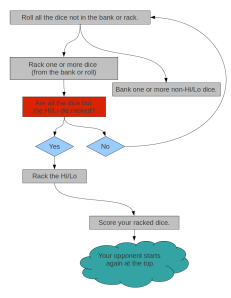
The mechanics are rather simple, the game is very quick to learn. Players roll five six sided dice in addition to the Hi/Lo die described above. Each roll, a player must rack at least one die, but they may bank one or more die from a roll. Dice that are racked or banked cannot be rerolled but dice from the bank may be racked. It is useful to bank extra desirable dice for moving to the rack later on. If your next roll is awful, you can move a die from the bank to the rack instead of from your roll to the rack. Once a player has racked all five dice, they must rack the Hi/Lo die if they haven’t done so already.
$\begin{array}{ccccccccccc} Hi &30 & 29 & 28 & 27 & 26 & 25 & 24 & 23 & 22 \leq \\ Lo & 5 & 6 & 7 & 8 & 9 & 10 & 11 & 12 & 13 \geq \\ \hline Pnts & 10 & 8 & 7 & 6 & 5 & 4 & 3 & 2 & 1\\ \end{array} $
Scoring is also rather simple. Once all the dice, including the Hi/Lo die, are racked, a player scores their hand. A player takes the sum of the pips on their racked dice and finds the value in the row corresponding to whether the Hi/Lo die reads Hi or Lo. The hand is then worth the number of points given in the last row of the table above. The player then scores the worth of their hand multiplied by the number showing on the Hi/Lo die.
Example: A player racks $1,1,1,4,4, 2\downarrow$. They then read off the worth of an eleven point hand when the Hi/Lo die reads Lo. Their hand is worth three points. Since the Hi/Lo die reads $2\downarrow$ they score six points.
Published: Aug 25, 2011 @ 00:00.
Last Modified: Aug 31, 2026 @ 21:59.
Thanks for reading! If you have any comments or questions about the content, please let me know. Anyone can contact me by email.