This post was imported from Playing with Games, an old gaming blog that I co-wrote with Megan. The authorship and formatting might be mixed up. If you spot any issues, please let me know.
For a game with so few materials, Pig can be very risky, stressful and intense. It is well suited for playing with children and impulsive gamblers.
Bits:
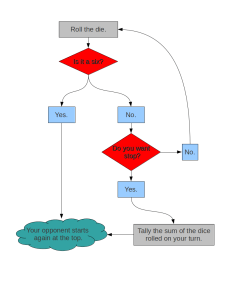
Pig is played with just one six sided die. The object of the game is to reach a predetermined total first. Players alterate taking turns, and on each turn the active player rolls the die one or more times. A turn is over either when the player chooses (says “stop”) or when she/he rolls a six. If you roll a six, you lose your turn and the next player goes. Otherwise, at the end of the turn, a player adds sum of the dice rolled during their turn to a running tally of their total.
Example: Player 1 rolls: 1,3,2,5,2,1,4 and says “Stop”. Player 1 tallies 18 points. Player 2 rolls: 5,3,5,1,6 and is forced to end their turn. Player 2 score no points. Player 1 rolls: 3,5,5,6 and is forced to end their turn. Player 1 scores no points. Player 2 rolls: 1,4,2 and says “Stop”. Player 2 scores 7 points.
After this example Player 1 has 18 points on their tally and Player 2 has 7.
We like to play to 100 or more, depending on how much time we have. Often we’ll use a cribbage board to keep score.
Take some chances, but don’t take too many chances - unless you’re exceptionally lucky. Generally one should aim for the high teens; that said, few turns will score over twenty five.
Published: Sep 9, 2011 @ 00:00.
Last Modified: Aug 31, 2026 @ 21:59.
Thanks for reading! If you have any comments or questions about the content, please let me know. Anyone can contact me by email.