Recently, while camping, I played a bunch of Spot It. In this game every card shows a collection of symbols and any two cards have exactly one symbol in common. How would one go about creating a deck for such a game?
It seems like a tricky problem. There needs to be a certain amount of overlap between the cards but not too much. It feels very rigid; almost crystalline. Fortunately, we don’t have to invent one from scratch. Mathematicians have been thinking about such configurations for hundreds of years.
In a course on classical geometry, we learn about projective space where every two lines meet in exactly one point1. This suggests that a Spot It deck2 could be a finite projective plane. I spent a fair bit of the rest of the camping trip noodling around with finite project planes.
In particular, I wanted to play with the construction based on $\mathbb{Z}_2^3 \setminus{ (0,0,0) }$ because it is easy to visualize and the quotient operation $\mathbf{x} = -\mathbf{x}$ happens “for free” in $\mathbb{Z}_2$ because $-1 \equiv 1 \mod 2$. In $\mathbb{Z}_2^3 \setminus{ (0,0,0) }$ there are seven vectors. We pick all $\binom{7}{2} = 21$ pairs of vectors and see what planes they generate. We get the following list of possible cards in our deck.
| Vertices in Plane | Basis of Plane | Office Camera Photo |
|---|---|---|
| $\{ 001, 010, 011 \}$ | $\langle 001, 010 \rangle$ | Part 5 |
| $\{ 001, 010, 011 \}$ | $\langle 001, 011 \rangle$ | Part 4 |
| $\{ 001, 010, 011 \}$ | $\langle 011, 010 \rangle$ | Part 4 |
| $\{ 001, 100, 101 \}$ | $\langle 100, 001 \rangle$ | Part 5 |
| $\{ 001, 100, 101 \}$ | $\langle 100, 101 \rangle$ | Part 4 |
| $\{ 001, 100, 101 \}$ | $\langle 101, 100 \rangle$ | Part 4 |
| $\{ 001, 110, 111 \}$ | $\langle 001, 110 \rangle$ | Part 3 |
| $\{ 001, 110, 111 \}$ | $\langle 001, 111 \rangle$ | Part 1 |
| $\{ 001, 110, 111 \}$ | $\langle 110, 111 \rangle$ | Part 2 |
| $\{ 010, 100, 110 \}$ | $\langle 010, 100 \rangle$ | Part 5 |
| $\{ 010, 100, 110 \}$ | $\langle 100, 110 \rangle$ | Part 4 |
| $\{ 010, 100, 110 \}$ | $\langle 110, 010 \rangle$ | Part 4 |
| $\{ 010, 101, 111 \}$ | $\langle 010, 111 \rangle$ | Part 1 |
| $\{ 010, 101, 111 \}$ | $\langle 101, 010 \rangle$ | Part 3 |
| $\{ 010, 101, 111 \}$ | $\langle 101, 111 \rangle$ | Part 2 |
| $\{ 011, 100, 111 \}$ | $\langle 011, 100 \rangle$ | Part 3 |
| $\{ 011, 100, 111 \}$ | $\langle 011, 111 \rangle$ | Part 2 |
| $\{ 011, 100, 111 \}$ | $\langle 100, 111 \rangle$ | Part 1 |
| $\{ 011, 101, 110 \}$ | $\langle 011, 110 \rangle$ | Part 5 |
| $\{ 011, 101, 110 \}$ | $\langle 101, 011 \rangle$ | Part 5 |
| $\{ 011, 101, 110 \}$ | $\langle 110, 101 \rangle$ | Part 5 |
Notice that every row appears three times. Thus, there are only seven distinct cards. One way to get at this directly is the following: Every pair of vectors will generate three vertices. Each plane has exactly three ways to pick a basis. If the deck has $N$ cards we get: \[ 3 N = \binom{7}{3} = 21 = 3 \cdot 7 \Longrightarrow N = 7. \]
Taking just the unique rows, we get the following deck of cards.
| Vertices in Plane | Basis of Plane | Office Camera Photo |
|---|---|---|
| $\{ 001, 010, 011 \}$ | $\langle 001, 010 \rangle$ | Part 5 |
| $\{ 001, 100, 101 \}$ | $\langle 100, 001 \rangle$ | Part 5 |
| $\{ 001, 110, 111 \}$ | $\langle 001, 110 \rangle$ | Part 3 |
| $\{ 010, 100, 110 \}$ | $\langle 010, 100 \rangle$ | Part 5 |
| $\{ 010, 101, 111 \}$ | $\langle 010, 111 \rangle$ | Part 1 |
| $\{ 011, 100, 111 \}$ | $\langle 011, 100 \rangle$ | Part 3 |
| $\{ 011, 101, 110 \}$ | $\langle 011, 110 \rangle$ | Part 5 |
And so, we’ve stumbled in to The Fano Plane. It is notable, to me, that we didn’t need to use any of the material from Build Spot It Pt. 2 or Build Spot It Pt. 4. There must be a nice linear algebra explanation of this fact. The numbers or so small and the whole setup is so concrete, that we should be able to come up with a super elegant way to get to the seven planes.
A little Googling reveals that a blog Games for Young Minds has written about this $N = 7$ deck. They even made an example deck based on the Fano plane.
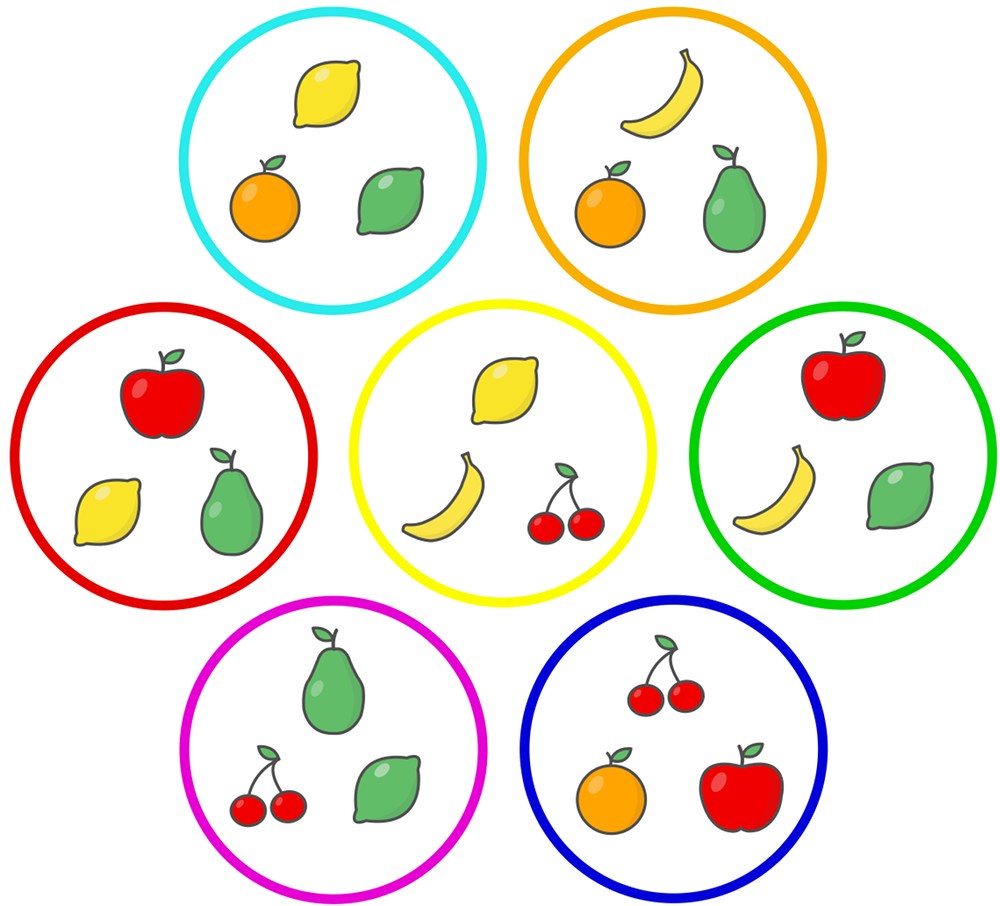
– Image by Kent Haines.
A bit of a cultural aside. As we were camping, I got chatting with my friend about the mathematics underlying all this. They have a math degree, so I was expecting things to go smoothly. I warned them saying: “Alright, my explanation of Spot It is going to be a bit abstract. We’ll start really concrete and get in to abstract algebra quickly.” I started with: “Let’s think about a sphere. On a sphere, lines are great circles. Every pair of distinct great circles meets at two points which is sort of like Spot It.” This was met with shocked disbelief and asking if we were talking about the same game. A sort of incredulous “What could spheres have to do with Spot It?!” ↩︎
The actual game is a finite projective plane of order seven which has lines missing due to issues with printing. ↩︎
Published: May 25, 2026 @ 09:01.
Last Modified: Aug 31, 2026 @ 21:59.
Thanks for reading! If you have any comments or questions about the content, please let me know. Anyone can contact me by email.