
Menu

Office Camera

There is a webcam in my office that I use to take photos of the whiteboard. This setup was inspired by Dror Bar Natan’s Blackboard Shots. You can read more about the setup here. If you know of anyone else with a similar setup, please let me know.

This page generates an RSS Feed.

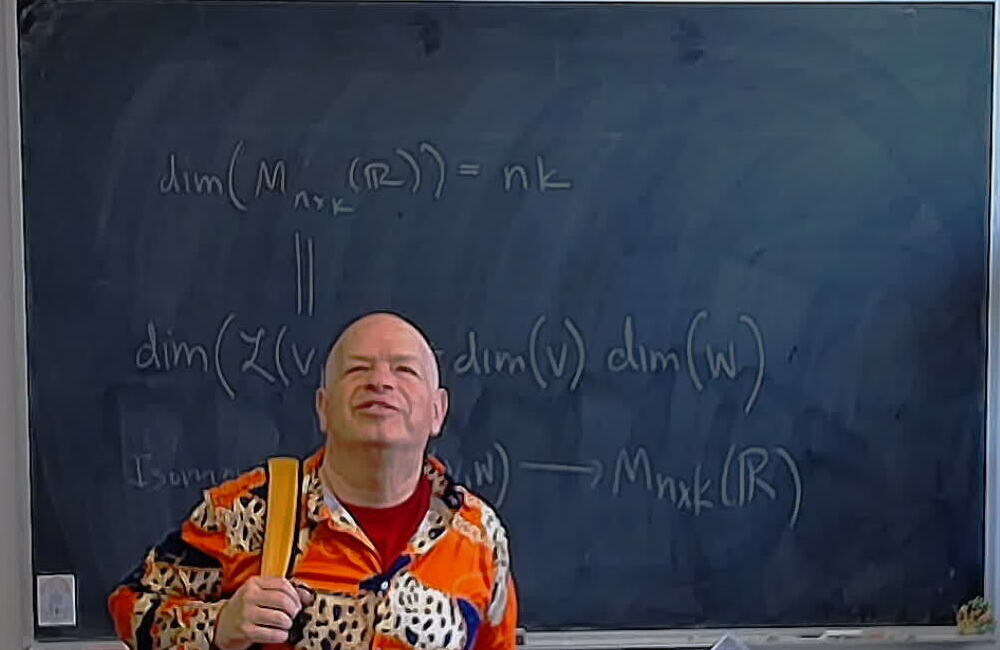
MAT B42: HW 2 Q 2

A photo of a whiteboard titled: MAT B42: HW 2 Q 2

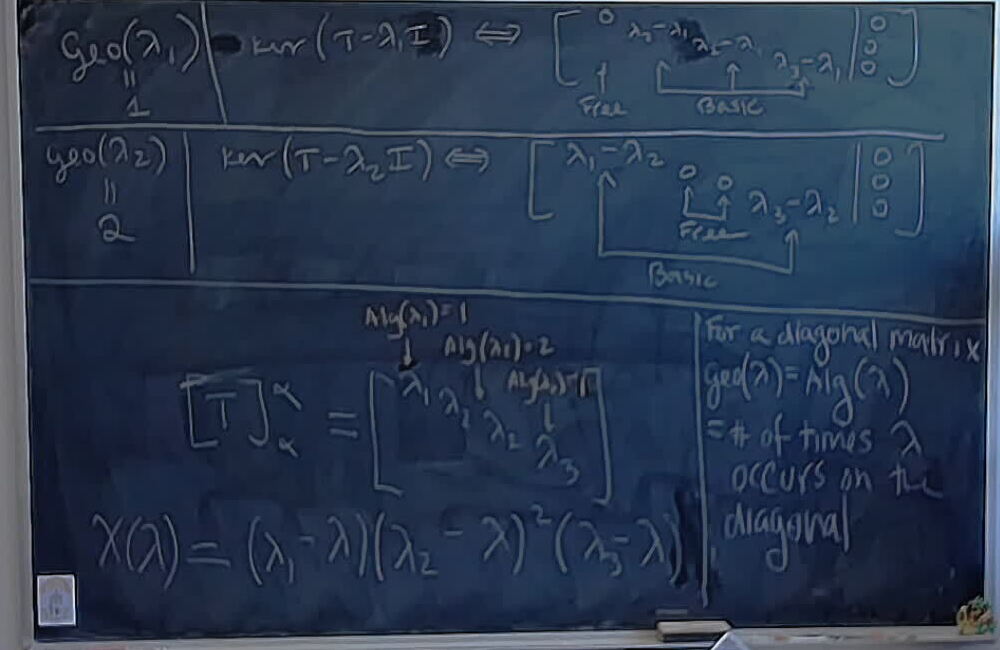
MAT B42: HW 4 Q 3

A photo of a whiteboard titled: MAT B42: HW 4 Q 3

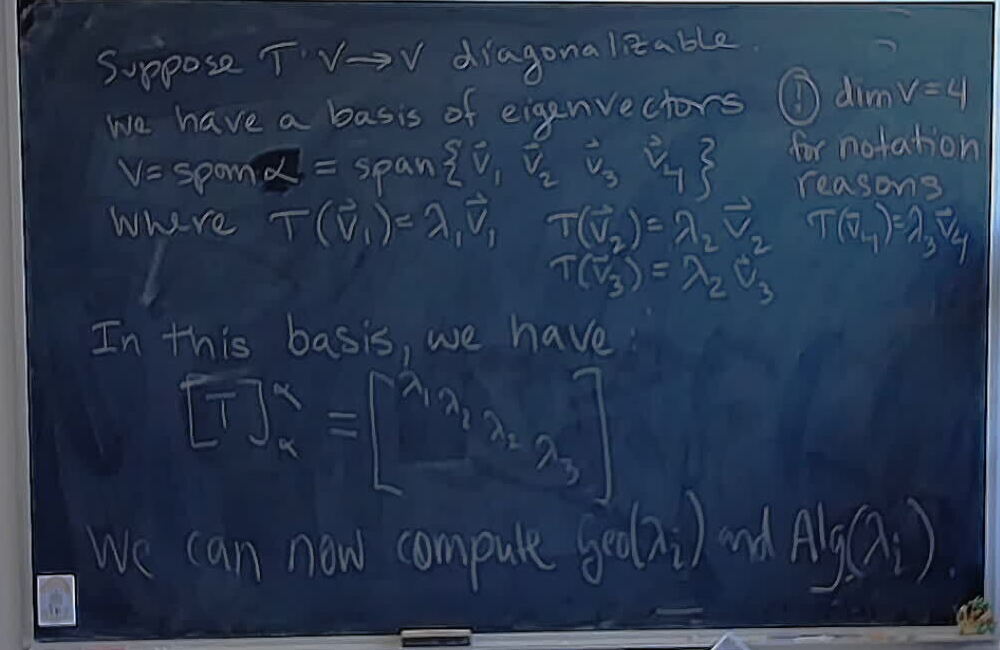
Sundials and Equinoxes

A photo of a whiteboard titled: Sundials and Equinoxes

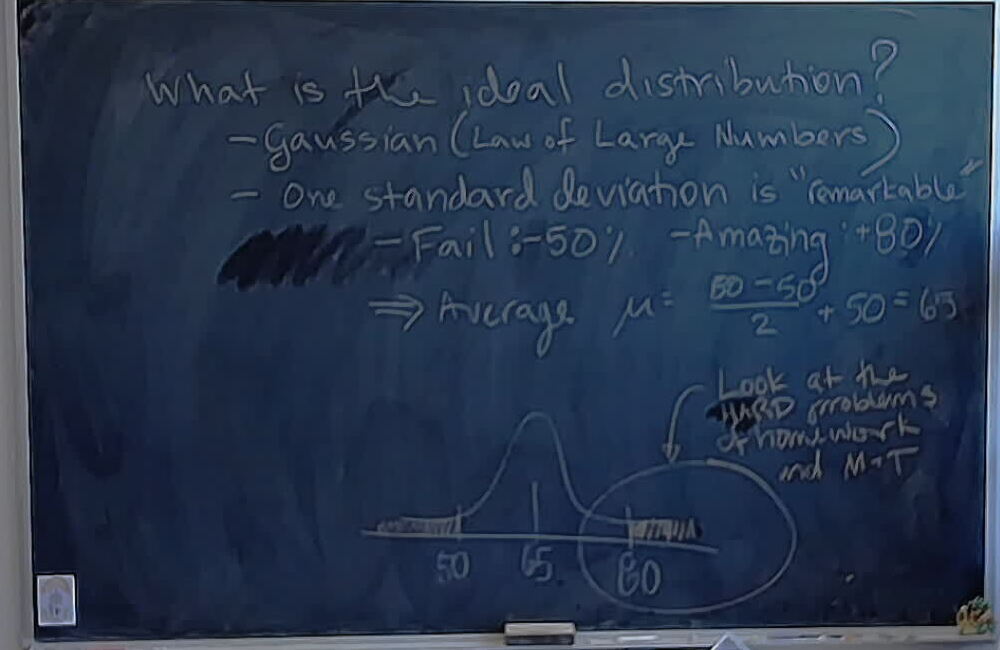
Divy

Divy wanted to come in and see the World Famous Office Camera.

A photo of a whiteboard titled: Divy

Two Notions of Orientation

A photo of a whiteboard titled: Two Notions of Orientation

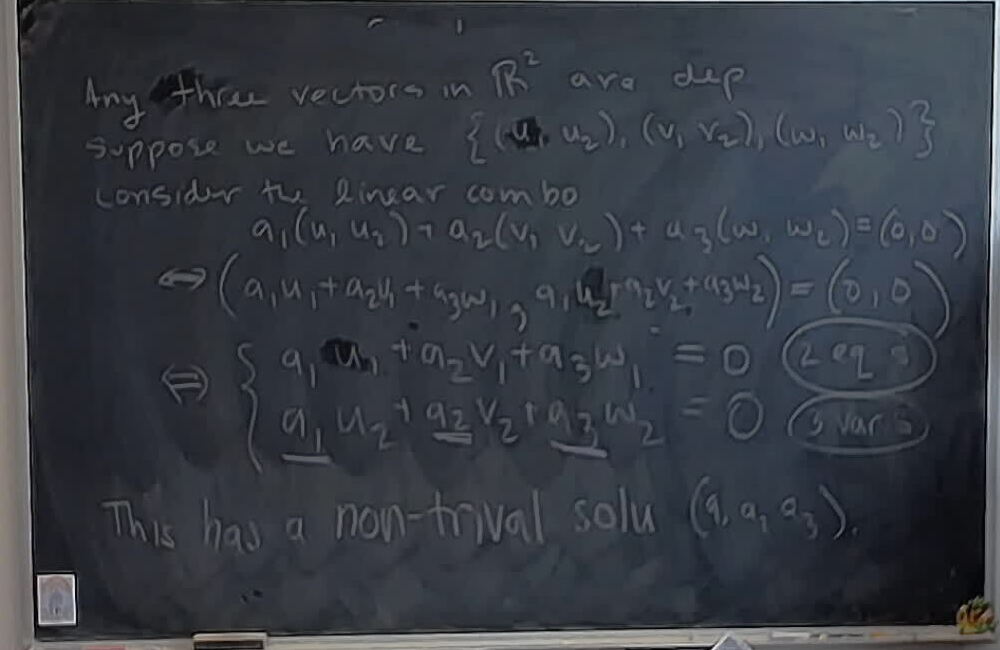
Extending a Indep Set to a Basis

A photo of a whiteboard titled: Extending a Indep Set to a Basis

Substitution: Changing Bounds

A photo of a whiteboard titled: Substitution: Changing Bounds

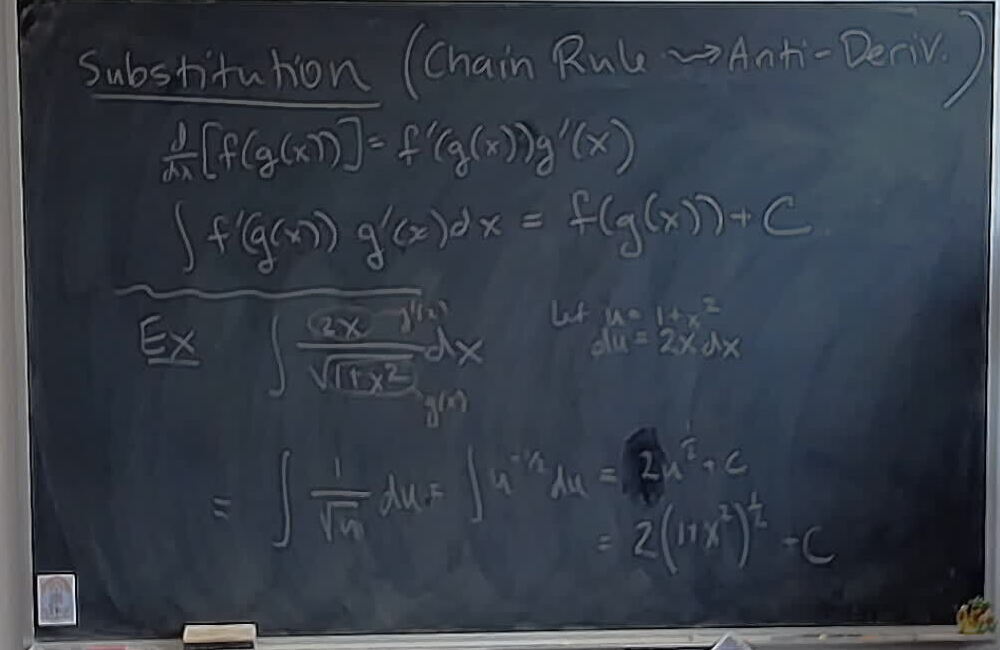
Substitution

A photo of a whiteboard titled: Substitution

Determinant, Volume, and Collapse

A photo of a whiteboard titled: Determinant, Volume, and Collapse

B42: Integral over Sphere Meets Plane: Paco's Fix

A photo of a whiteboard titled: B42: Integral over Sphere Meets Plane: Paco’s Fix

A student came to me asking about the intended solution of the integral shown on the top of the board. After playing around with the parametrization for a long while, we couldn’t get it to match the given curve. Our idea was: “Start with a circle in the plane and tilt it appropriately.”

  1. Start with $\mathbf{c}_0 = (\cos(t), \sin(t), 0)$
  2. Rotate in the $xy$-plane by $\pi/4$ to obtain $\mathbf{c}_1$
  3. Rotate in the $yz$-plane by $\pi/4$ to obtain $\mathbf{c}_2$

This didn’t seem to work and we couldn’t figure out why. I asked my colleague Paco what as going on and he suggested that we approach it with spherical coordinates. The spherical coordinates of the normal $\mathbf{n} = (1,1,1)$ are $\theta = \pi/4$ and $\phi$ given by:

\[ \left\langle (1,1,1), (0,0,1) \right\rangle = \cos(\phi) \left\lVert (1,1,1) \right\rVert \left\lVert (0,0,1) \right\rVert \Longrightarrow \cos(\phi) = \frac{1}{\sqrt{3}} \]

I want to emphatical highlight the fact that $\phi$ is not a nice angle that you bump in to everyday. And yet, by the Pythagorean identity, we know:

\[ \cos(\phi) = \frac{1}{\sqrt{3}} \quad \quad \sin(\phi) = \sqrt{\frac{2}{3}}. \]

This suggests the following revised plan:

  1. Start with $\mathbf{c}_0 = (\cos(t), \sin(t), 0)$
  2. Rotate the $xz$-plane by $\cos(\phi) = 1/\sqrt{3}$ to get $\mathbf{c}_1$.
  3. Rotate the $xy$-plane by $\theta = \pi/4$ to get $\mathbf{c}_2$.

Putting the pieces together we get:

\[ \begin{array}{rcl} \mathbf{c}_2(t) & = & \begin{bmatrix} \cos(\theta) & \sin(\theta) & 0 \\ -\sin(\theta) & \cos(\theta) & 0\\ 0 & 0 & 1 \end{bmatrix} \begin{bmatrix} 1 & 0 & 0 \\ 0 & \cos(\phi) & \sin(\phi) \\ 0 & -\sin(\phi) & \cos(\phi) \\ \end{bmatrix} \begin{bmatrix} \cos(t) \\ \sin(t) \\ 0 \end{bmatrix} \\ & = & \begin{bmatrix} \frac{1}{\sqrt{2}} & \frac{1}{\sqrt{2}} & 0 \\ -\frac{1}{\sqrt{2}} & \frac{1}{\sqrt{2}} & 0\\ 0 & 0 & 1 \end{bmatrix} \begin{bmatrix} 1 & 0 & 0 \\ 0 & \frac{1}{\sqrt{3}} & \sqrt{\frac{2}{3}} \\ 0 & -\sqrt{\frac{2}{3}} & \frac{1}{\sqrt{3}} \\ \end{bmatrix} \begin{bmatrix} \cos(t) \\ \sin(t) \\ 0 \end{bmatrix} \\ & = & \begin{bmatrix} \frac{1}{\sqrt{2}} & \frac{1}{\sqrt{2}} & 0 \\ -\frac{1}{\sqrt{2}} & \frac{1}{\sqrt{2}} & 0\\ 0 & 0 & 1 \end{bmatrix} \begin{bmatrix} \cos(t) \\ \frac{1}{\sqrt{3}}\sin(t) \\ -\sqrt{\frac{2}{3}}\sin(t) \end{bmatrix} \\ & = & \begin{bmatrix} \frac{1}{\sqrt{2}} \cos(t) + \frac{1}{\sqrt{6}} \sin(t) \\ -\frac{1}{\sqrt{2}} \cos(t) + \frac{1}{\sqrt{6}} \sin(t) \\ -\sqrt{\frac{2}{3}}\sin(t) \end{bmatrix} \\ \end{array} \]

And you can check out the final curve on CalcPlot3D.


Navigation Menu

Home / Now / Blog / Notes / Reading / Office Camera / Tags / Bookmarks / RSS Feeds / Top of Page

Thanks for reading! If you have any comments or questions about the content, please let me know. Anyone can contact me by email.