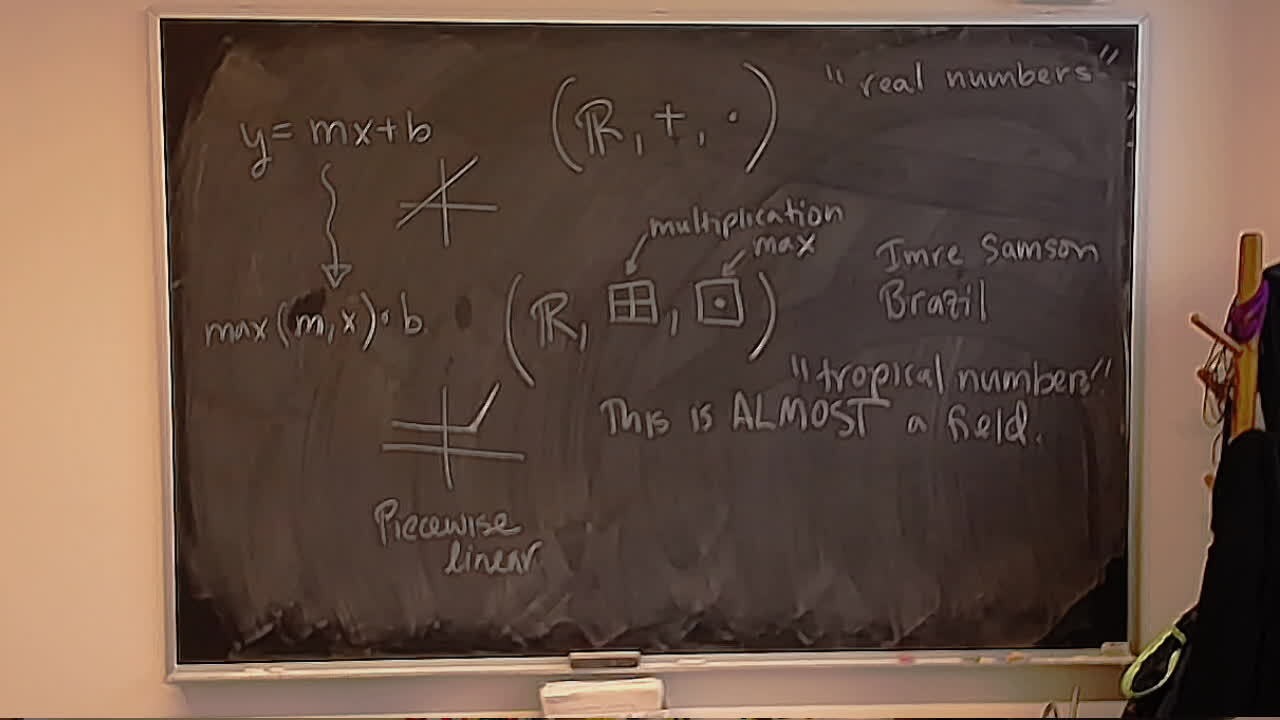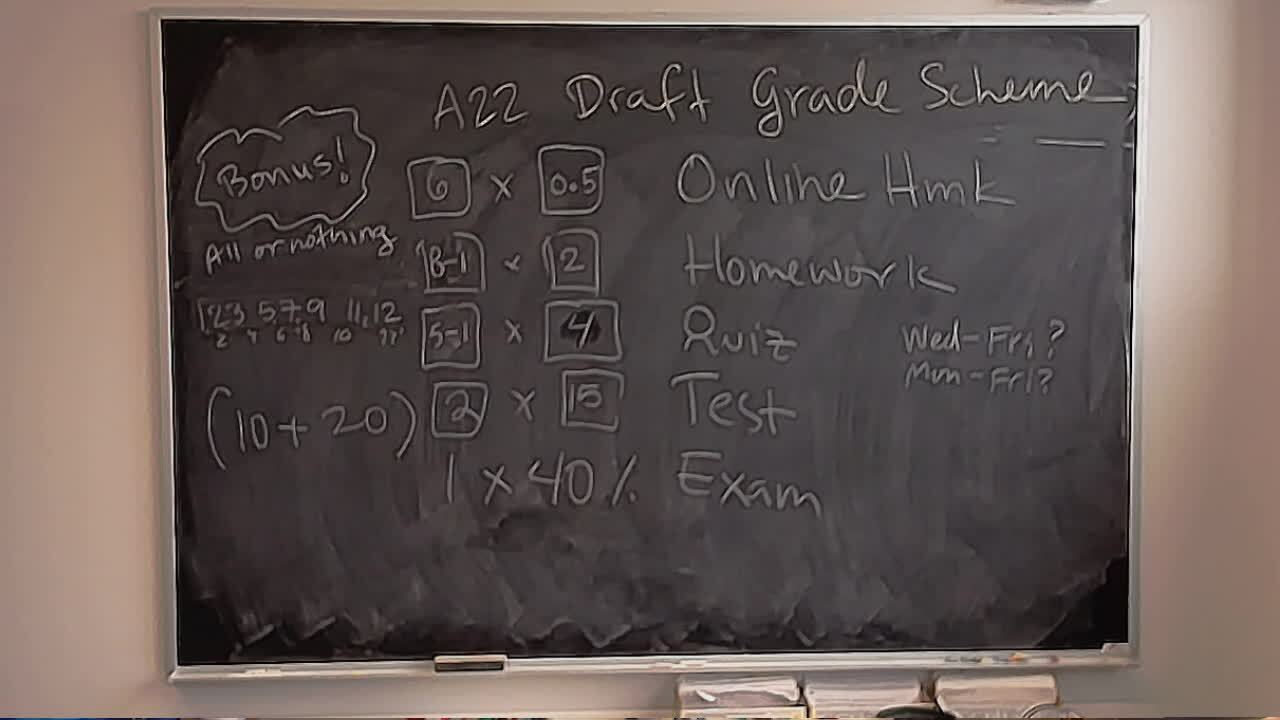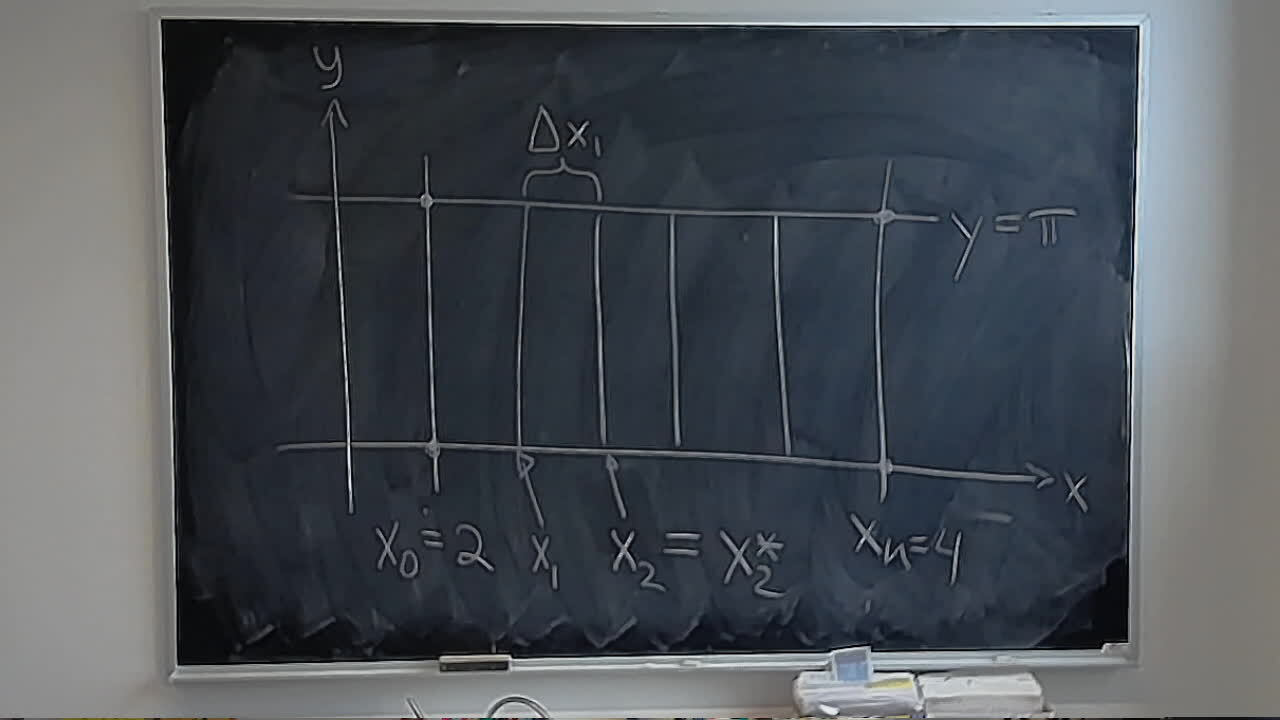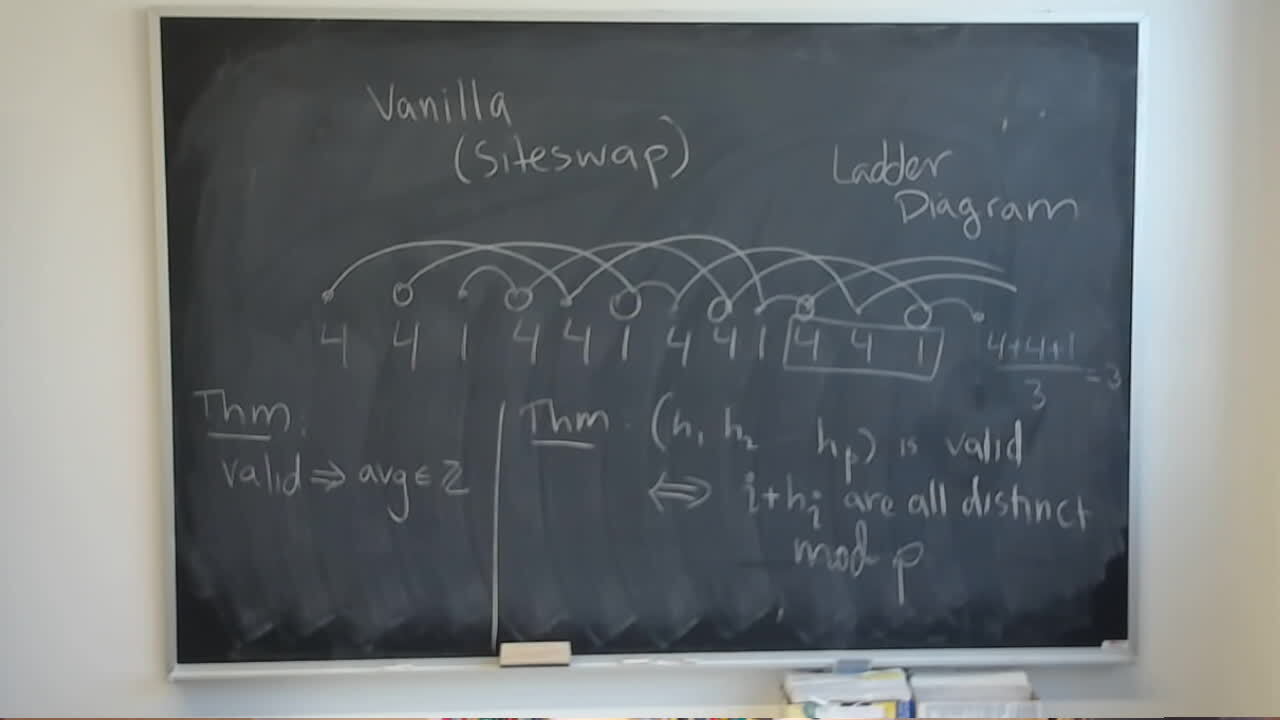

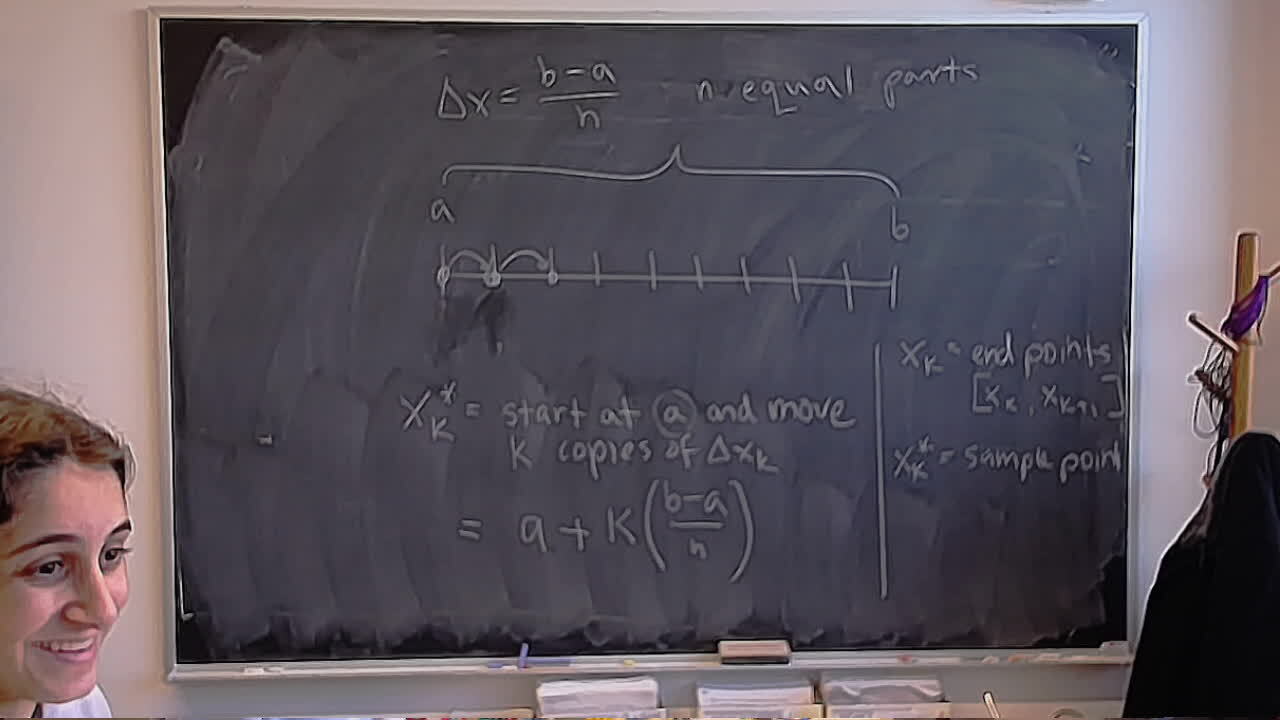
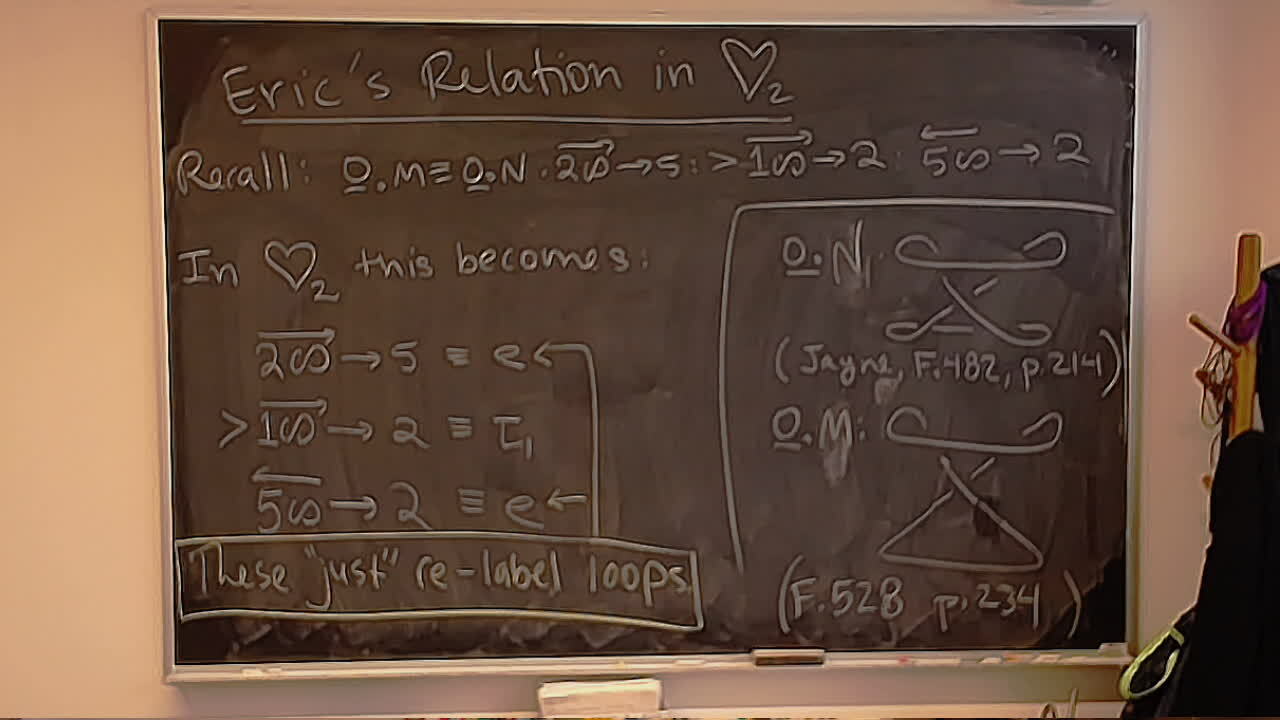
There is a webcam in my office that I use to take photos of the whiteboard. This setup was inspired by Dror Bar Natan’s Blackboard Shots. You can read more about the setup here. If you know of anyone else with a similar setup, please let me know.
This page generates an RSS Feed.
My colleague Nick Cheng asked about the curve $f(p) = x^p - x$ for $x \in (0,1)$ and $p \in (0,1)$. He was interested in where the maximum is for various values of $p$.
We check the end-points and see: $f(0) = f(1) = 0$. These are probably not our maxima. Now, we look for critical points: \[ f’(p) = px^{p-1} - 1 = 0 \Longrightarrow x^{p-1} = \frac{1}{p} \Longrightarrow x = p^{-\frac{1}{p-1}} \] And so, a bit of calculus says that the max should occur at $x = p^{-\frac{1}{p-1}}$.


The office webcam has been offline since mid-August because of a move. The whole math department moved to a new building, and the camera got packed away. It is nice to have it back online.


Here is a wonderful interactive essay about the spacing effect: How to Remember Anything Forever~ish.
I also really like this paper about how we’ve failed to apply this result to education:
Dempster, F. N. (1988). The spacing effect: A case study in the failure to apply the results of psychological research. American Psychologist, 43(8), 627–634. https://doi.org/10.1037/0003-066X.43.8.627


It shows the three generators $T_i, C_i, P_i$. This is a photo to accompany: The Loop Manipulation Group.


I’m working on a project which involves a finitely generated subgroup of the braid group which consists of “loop manipulations”. Three examples of the generators are shown. The question is: What should we call these generators?
We want some nomenclature which produces good notation for the group.
Home / Now / Blog / Notes / Reading / Office Camera / Tags / Bookmarks / RSS Feeds / Top of Page
Thanks for reading! If you have any comments or questions about the content, please let me know. Anyone can contact me by email.